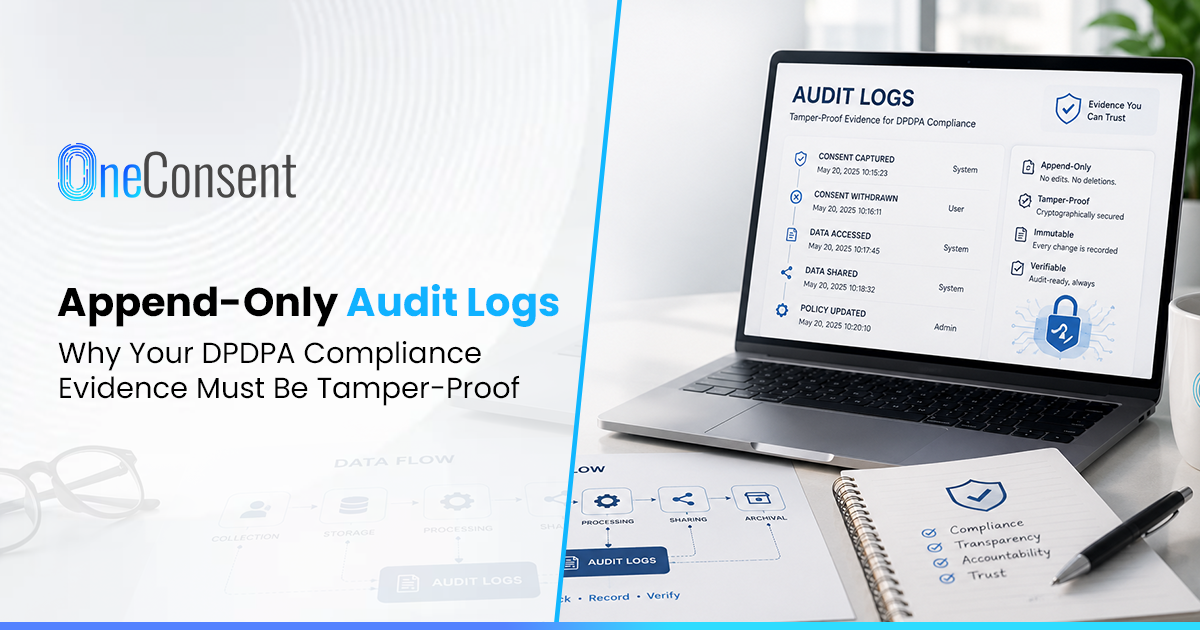
Append-Only Audit Logs: Why Your DPDPA Compliance Evidence Must Be Tamper-Proof
The difference between passing a Data Protection Board investigation and failing one often comes down to the quality of your audit trail. Mutable logs are not compliance evidence.
The Data Protection Board of India opens an inquiry into a complaint against your company. Within the first few exchanges, they ask for one thing: your consent audit trail. Who consented, when, for what purpose, under which version of your Notice, and what happened to that consent afterward.
Now picture the second scenario. Someone on your team, months ago, quietly edited a record because it "looked wrong." Maybe it was an honest mistake they were trying to fix. Maybe it was a timestamp that didn't line up. Either way, that log has now been touched after the fact and the moment it can be touched, it stops being evidence. It becomes a liability sitting in your database, waiting to be found.
This is the uncomfortable truth a lot of businesses don't confront until it's too late: if your audit log can be edited, deleted, or overwritten even by a well-meaning administrator with the best intentions, it will not hold up under scrutiny. Tamper-proof, append-only audit infrastructure isn't a nice-to-have feature bolted onto a consent management system. It's the foundation the rest of the system stands on.
Why Mutable Logs Just Don't Cut It
Here's the problem with an ordinary database record, the kind sitting in a typical CRM field right now. It can be updated. And that single fact quietly reduce its value as evidence in four distinct ways.
First, it can't prove what the consent status actually was at any given moment in time because whatever's there now might not be what was there then. Second, it can't rule out the possibility that something was changed in between, even if nothing was. Third, if a regulator or a court ever questions its authenticity, there's no way to verify it wasn't altered. And fourth, this one catch people off guard — even editing a record to correct a compliance error after the fact is, in itself, a compliance problem. You can't fix history by rewriting it.
Most relational databases, including the CRM systems businesses lean on every day, simply weren't built with this in mind. They're built for convenience, not for evidentiary integrity. Those are two very different design goals.
The Append-Only Principle, Explained Simply
An append-only consent event store flips the logic entirely. Instead of storing "current state" and overwriting it whenever something changes, it treats every single action as its own permanent, unchangeable event.
A grant of consent is an event. A withdrawal is an event. A purpose change is an event. A Notice version update is an event. Each one gets written once, stamped with a timestamp and a unique event ID, and never touched again. If you want to know someone's current consent status, the system doesn't look up a single field — it replays the entire history of events for that person, in order, to arrive at the answer.
It sounds almost old-fashioned in its simplicity, but that's exactly the point. Nothing gets modified. Nothing gets deleted. The full history stays intact and, crucially, auditable from end to end.
Building Trust Through Verifiable Consent Records
Append-only storage alone is a strong start, but the best consent audit systems go a step further with something called hash chaining.
Here's the idea. Every event record contains a cryptographic hash of the event that came right before it. That creates a chain — each link depending on the one before it. If anyone tries to alter a historical record, even something small, the hash for that record no longer matches, which breaks the chain going forward. The tampering doesn't stay hidden. It shows up immediately, and it's provable, not just suspected.
This is a meaningful upgrade from "we have a policy that says nobody edits old records." A policy relies on trust and discipline. Hash chaining relies on math. One of those is a lot harder to argue with in front of a regulator.
What Actually Needs to Be in Every Event Record
It's not enough to just log "something happened." A useful, defensible consent event record needs real substance behind it:
Event type — was it a grant, a withdrawal, a purpose change, or a Notice update?
Timestamp — recorded in UTC, with timezone information included
Data Principal identifier — who this event belongs to
The exact Notice version shown to the person at that moment
The channel the event happened through — web, mobile app, in person, or voice
Source IP or session identifier, wherever that's applicable
Miss any one of these fields and you create a gap — a place where the story of what happened becomes incomplete, and incomplete stories don't inspire confidence in an investigation.
How Long Should You Keep All This?
Long enough to matter, basically. Given that a Board investigation could reach back to events from several years earlier, the safest approach is to treat consent audit logs as something you retain indefinitely, or at the very least for the full duration of the customer relationship plus a meaningful buffer afterward. Deleting old audit data to "save space" is a decision that can come back to bite you at exactly the wrong moment.
Handling This at Real Scale
All of this gets genuinely difficult once you're not talking about a few thousand customers but millions, across multiple purposes and touchpoints. Writing immutable, high-volume events fast enough while still being able to query them quickly for reporting is a serious engineering problem.
This is where columnar databases like ClickHouse tend to earn their keep. They're purpose-built for append-only, high-volume event ingestion paired with fast analytical querying, which happens to be almost exactly what consent audit logging demands. They let organisations keep the tamper-evident pattern intact while still generating the compliance reports that regulators and your own internal governance team will ask for.
Closing Thoughts
Tamper-proof audit infrastructure isn't some advanced feature you add later once the "important stuff" is done. Under DPDPA, it effectively is the important stuff — it's the operational definition of what counts as compliance evidence in the first place. Get the foundation right the first time, and you're not just checking a box. You're building something that will hold up every single time a regulator comes asking.
OneConsent is built on append-only consent event architecture with cryptographic hash chaining providing audit evidence that stands up to Data Protection Board scrutiny.
Frequently Asked Questions
Have more questions?
Search our full DPDP knowledge base for more answers.