Consent Manager Integration Under DPDP: What to Demand from Your Vendor
What to check before connecting a registered Consent Manager to a CRM and campaign tools, covering consent records, withdrawal handling, API failures and the evidence to request from a vendor.
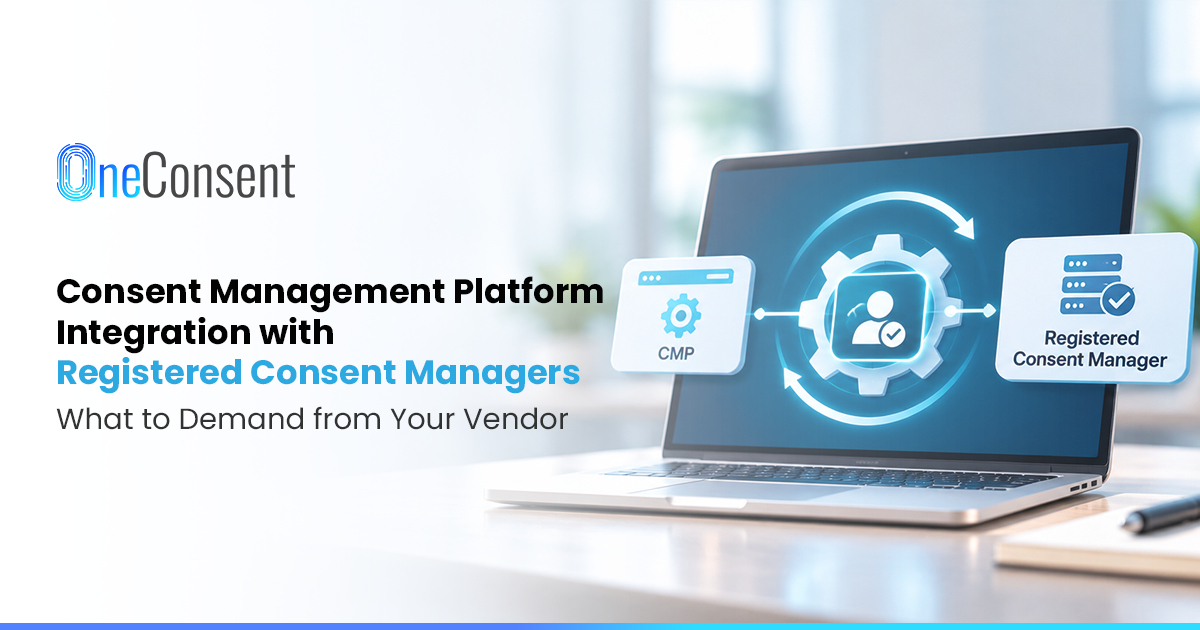
A vendor proposal for consent manager integration under DPDP needs to explain what happens after a customer changes a choice. The CRM may hold one record, the campaign tool another, and the external Consent Manager a third. The buyer needs to know which record governs processing and how conflicting updates are resolved.
API support can mean anything from a connection that exchanges records overnight to one that updates permissions before the next customer interaction. That difference affects implementation cost, campaign operations and the evidence available during a compliance review. It belongs in the procurement discussion early.
Consent Manager Registration and Integration Scope
Consent Manager registration opened on 13 November 2026. MeitY's announcement on 14 November distinguishes that milestone from the main Data Fiduciary duties and Data Principal rights provisions scheduled for 13 May 2027. Before accepting your vendor's proposal for a registered Consent Manager connection, verify the named entity's registration with the Data Protection Board.
The roles also need to be clear in the proposal. Section 6(7) allows an individual to give, manage, review or withdraw consent through a Consent Manager. The business uses its own consent management platform to apply choices across its operations. An integration connects the external service to those internal controls.
Your vendor can document the proposed connection by naming the Consent Manager, the interface version, the systems covered and any applicable Board specifications. An integration described as planned needs a delivery commitment, a price and an owner. These details help procurement distinguish available functionality from work that will be built during implementation.
The requirements below are practical evaluation criteria. Rule 4 and the First Schedule establish the registration and interoperability framework; they do not prescribe the API message format presented in a vendor's proposal.
How Consent Manager Integration Works with Your CRM
A consent management API for CRM integration has to connect an external reference to the right customer account. This requires care where the CRM contains duplicate leads, a shared phone number or records merged after consent was captured. Granting permission against the wrong profile would affect a different person's data.
Review the field mapping with your CRM owner. It needs to explain how a match is established, what happens when the match is uncertain and which team resolves it. An ambiguous record can be held for review while optional processing remains paused.
Purpose mapping follows. A customer agreeing to promotional email has made a different choice from a customer authorizing the sharing of an account statement. The integration needs to preserve the recipient business, purpose and data scope attached to each decision. A single customer-level flag would lose those distinctions.
For teams planning how to capture consent under DPDP, the same review should cover choices collected through existing channels. A withdrawal received from the external service may arrive between two local updates. Your design needs a rule for establishing the current choice without allowing an older record to restore permission.
Consent Artefact Requirements for Integration
A consent artefact is the record used to establish what the individual agreed to. The guide to consent artefacts under DPDP covers the evidence fields. Your integration review can follow how another system reads and acts on that record.
Request a sample message and follow it through the proposed connection. The customer reference, purpose, notice version and consent action need consistent meanings on both sides. Event identifiers and state versions help distinguish a new choice from a repeated delivery. Receipt times and destination acknowledgements show what happened after the message arrived.
The sample should also make clear which personal data crosses each connection. The First Schedule requires the contents of personal data made available or shared through the Consent Manager arrangement to be unreadable by the Consent Manager. Where records move between businesses, the architecture needs to explain how that condition is met. Carrying consent instructions and transferring the underlying account statement involve different data flows.
Consent Withdrawal Sync Across CRM and Campaign Systems
Consent withdrawal sync is easiest to assess through a campaign that is ready to send. A bank, for example, could use a test customer who has agreed to promotional email, add that customer to a queued campaign and then withdraw the permission through the external Consent Manager.
Follow the change through the CRM, the campaign queue and the delivery provider. The evidence needs to show when each system received the update, when the customer became ineligible for the promotion and whether a message had already passed the point where it could be cancelled.
For your procurement review, establish the point at which the message passes beyond cancellation. Updating the CRM cannot recall an email already delivered. A workable design identifies the final eligibility check before dispatch, the cancellation options available after handover and how further sends are prevented.
Section 6(6) provides for the Data Fiduciary and its processors to cease consent-dependent processing within a reasonable time after withdrawal, subject to its exception for processing required or authorized without consent. The provision does not assign a universal deadline in seconds. Your contract can set measurable response targets for the systems being connected, supported by the test results.
Keep the test specific to the withdrawn purpose. A marketing opt-out and an obligation to retain a banking record require different treatment. Legal and operations teams need to establish that distinction before the integration is configured.
Consent API Outages and Recovery
An outage can occur on either side of the connection. The external Consent Manager may be unreachable, or the business may have received a withdrawal while its campaign connector is offline. Each situation needs an operating procedure.
In the first case, the business needs to know how recent its available consent information is and whether it can rely on that information for the activity concerned. Where permission for optional outreach cannot be established, holding that outreach is a prudent policy. A failed lookup cannot establish consent.
In the second case, the withdrawal has already arrived. It needs to remain recorded, with the destination update marked as pending and assigned to a team that can resolve the failure. Retrying delivery should preserve the customer's choice throughout recovery.
An API success response also needs an agreed meaning. It might confirm that a message was received and saved, while the campaign platform is still waiting for an update. Your integration documentation can distinguish receipt, application within the privacy platform and confirmation from downstream systems. Operations teams can then see which work remains outstanding.
For the consent orchestration platform distributing these changes, review how a saved withdrawal becomes an outgoing notification. A transactional outbox is one possible design: it records the change and the notification together before delivery is attempted. For your environment, the vendor may propose another approach, provided it can demonstrate recovery when delivery fails.
Vendor Acceptance Tests for Consent Manager Integration
Retrying an event introduces another issue. The same withdrawal can arrive twice, or an earlier grant can arrive after a later withdrawal. Duplicate detection handles the repeated event. Ordering and reconciliation rules establish which choice is current.
Ask for both cases in the demonstration. Idempotency, the ability to process a repeat without making an additional change, is useful here. It does not establish the order of two different decisions. The integration needs a reliable version or another documented way to resolve their sequence; arrival time alone may give the wrong answer.
The following cases can form part of the acceptance schedule for consent manager integration under DPDP.
Acceptance scenario | Evidence to request |
Withdrawal with queued outreach | Trace the event through CRM, queue and delivery provider; show suppression and any cancellation limit. |
Duplicate event | Deliver the same event repeatedly; demonstrate one effective state change and a retained audit trace. |
Older grant arrives late | Apply a withdrawal, then replay an earlier grant; show the authoritative permission remains correct. |
Connector outage and recovery | Disconnect a destination; show the alert, pending update, replay and final reconciliation. |
Wrong customer or business account | Submit a mismatched reference; show rejection or quarantine without changing another record. |
Invalid or replayed request | Show failed authentication or replay checks and protected access to the relevant record. |
Access testing needs its own attention. An authenticated caller may still lack permission to change a particular customer's record. Test a request that uses valid credentials but refers to another business account. The expected result is rejection without changing that record.
Alongside the test results, your contract needs to name the support owner for each connection, explain how failed updates are escalated and allocate responsibility for API version changes. If recovery depends on custom middleware, include its maintenance costs. These are recurring operating responsibilities once the initial implementation is complete.
How OneConsent Supports DPDP Compliance
OneConsent supports DPDP compliance and data privacy operations through API-based integration, purpose-tagged consent records, consent synchronization and audit reporting.
For your proposed external Consent Manager connection, discuss the named counterparty, interface compatibility and deployment scope with the product team. A demonstration using the CRM and campaign systems in scope can establish what is available and what requires configuration or development.
Book a demo to review the connection, the withdrawal workflow and the evidence your team needs before approving the implementation.
Tiya Grover is a Marketing and Economics graduate from FLAME University and a Marketing Associate at Easyrewardz. She contributes to OneConsent’s growth through product marketing, content strategy, and digital marketing, with expertise in SEO and AEO. Her writing spans OneConsent’s products and capabilities, industry-specific applications of the Digital Personal Data Protection Act (DPDPA), and educational content on data privacy and consent management. She translates legal concepts and product features into clear, practical insights, helping businesses understand their obligations, evaluate consent solutions, and build customer trust.
See all articles by Tiya GroverFrequently Asked Questions
Have more questions?
Search our full DPDP knowledge base for more answers.