Data Fiduciary vs Data Processor vs Data Principal: Who Is Who Under DPDPA?
The DPDPA introduces three roles that define every data relationship in India. Get these wrong and your entire compliance framework is built on a misunderstanding.
The Role Confusion Nobody Talks About
Here's something that doesn't get said enough: a surprising number of Indian businesses currently preparing for DPDPA have misidentified their own role under the Act.
It's not because they're careless. It's because the roles look deceptively straightforward until you actually trace the data flows in a real organisation. A mid-sized D2C brand might think of itself purely as a Data Fiduciary. But the moment it starts processing order data on behalf of a marketplace partner, it's stepped into Processor territory — different obligations, different contracts needed, different compliance checklist entirely.
The DPDPA 2023 builds its entire architecture around three roles: Data Fiduciary, Data Processor, and Data Principal. Every obligation in the Act, every penalty exposure, every contract clause you need — all of it traces back to which role you occupy in a specific data relationship. Not in the abstract. In each specific flow.
The Data Principal: The Person This Law Exists to Protect
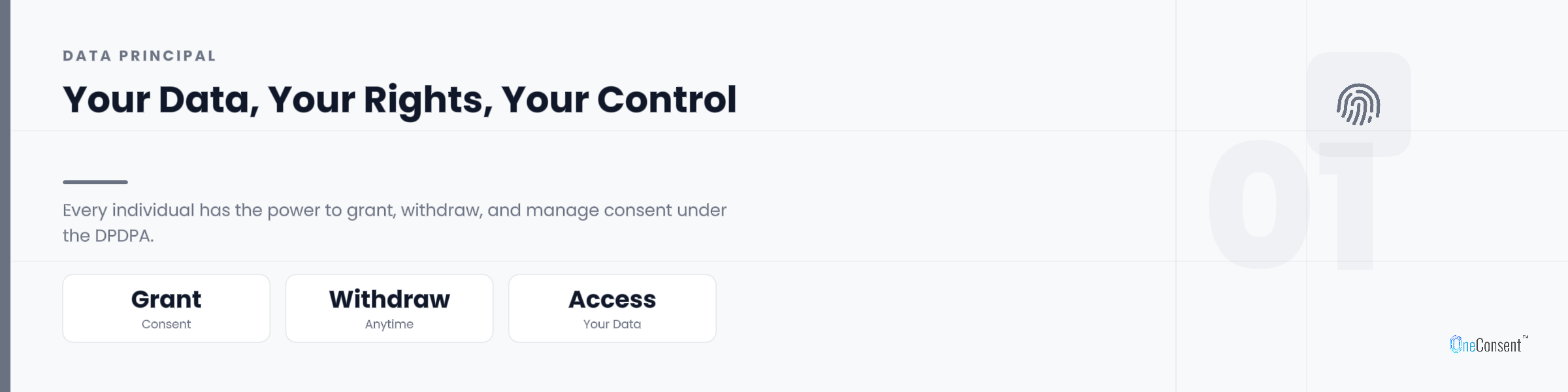
The Data Principal is the individual whose personal data is being processed. In most commercial contexts, this is your customer — the person who bought something on your app, applied for a loan, enrolled in a loyalty programme, or registered for a service.
But "customer" isn't always the right frame. A patient at a diagnostic centre is a Data Principal. So is a job applicant. So is the delivery partner whose GPS location your logistics system is tracking. The definition is deliberately broad.
Under the Act, Data Principals have real, enforceable rights — to access their data, correct it, request erasure, and withdraw consent. These aren't aspirational commitments buried in a policy PDF. They're legal entitlements your organisation must be operationally capable of honouring.
One thing worth noting: Data Principals also carry duties. The Act explicitly states they cannot file false complaints with the Data Protection Board or impersonate others in consent interactions. Rights work in both directions.
The Data Fiduciary: Where Most of the Compliance Weight Sits
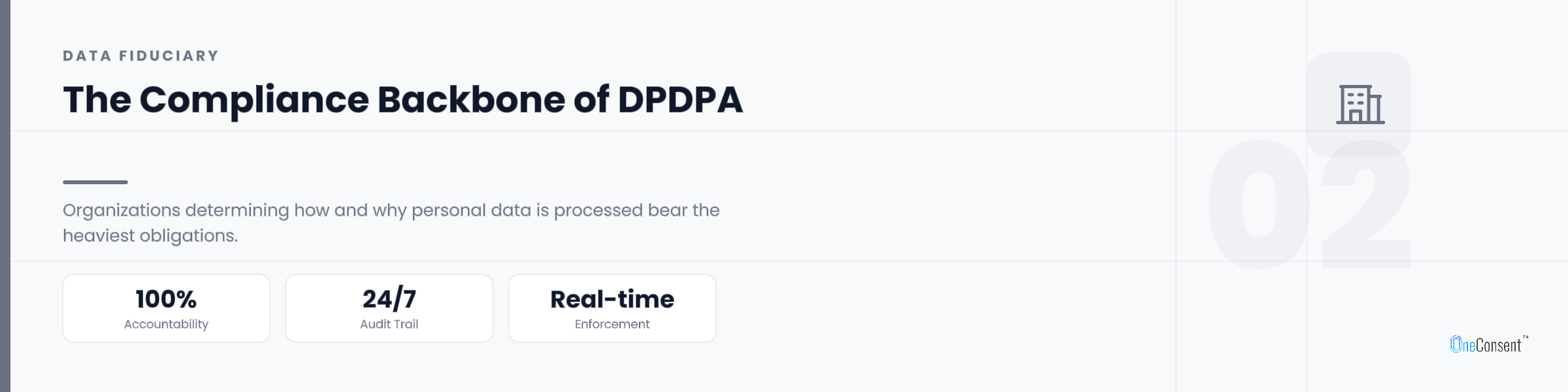
A Data Fiduciary is any entity that determines the purpose and means of processing personal data. Those two words — purpose and means — are the test.
If your organisation decides why customer data is collected and how it's used, you are a Data Fiduciary. Most businesses dealing directly with consumers fall squarely here. Your e-commerce platform personalising purchase recommendations? Data Fiduciary. Your bank deciding which customer fields to gather for KYC? Data Fiduciary. Your HR software company shaping how performance data flows through its system? Data Fiduciary.
The obligations that follow from this classification are substantial: obtaining valid consent under Section 6, providing a compliant Notice under Section 5, honouring withdrawal requests, fulfilling DSAR rights, appointing a Grievance Officer, maintaining security safeguards, and notifying breaches to the Data Protection Board and affected individuals. The compliance programme most companies are building is, at its core, a Data Fiduciary compliance programme.
What catches organisations off guard: a single company can be a Data Fiduciary for some data relationships and a Processor for others. These aren't permanent labels attached to a legal entity. They're role descriptions that apply to specific data flows.
The Data Processor: Executing Someone Else's Decision
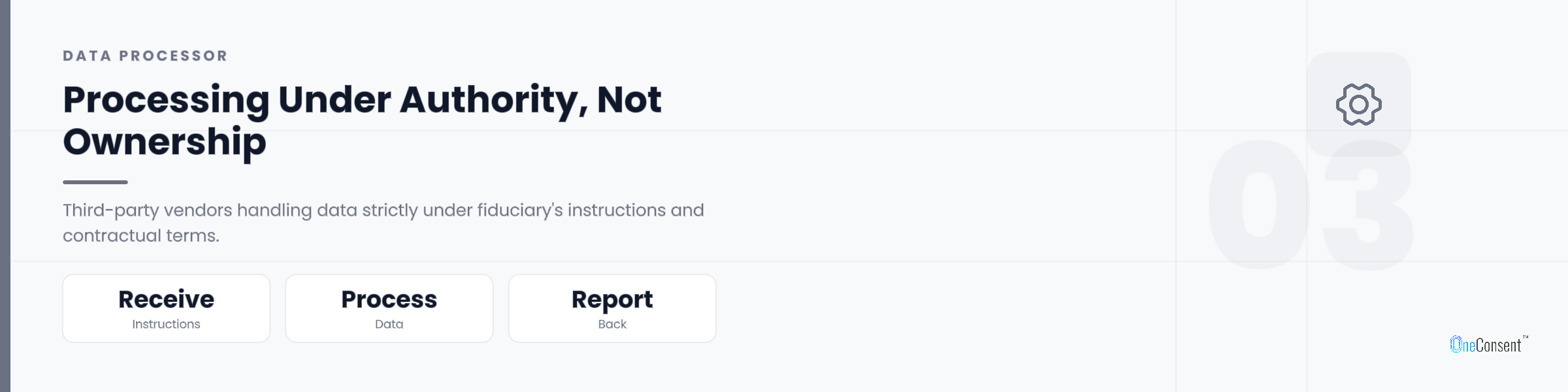
A Data Processor is any entity that processes personal data on behalf of a Data Fiduciary — and critically, pursuant to the Fiduciary's instructions. The Processor doesn't decide why data is collected or what it's used for. That's the Fiduciary's call. The Processor executes.
Cloud infrastructure providers, CRM vendors, email marketing platforms, analytics services, payroll software companies — all of these, when handling your customers' data to serve your business, are Data Processors.
The DPDPA places fewer direct obligations on Processors than on Fiduciaries. But "fewer" is not "none." Processors must operate within the scope of the Fiduciary's instructions, maintain appropriate security, and notify the Fiduciary promptly when breaches occur — because the Fiduciary can't meet their own Board notification timeline otherwise.
Here's what often gets missed: the Fiduciary remains responsible. If your Processor mishandles personal data, regulatory scrutiny lands on you first. Your contracts with Processors aren't a formality — they're how you create enforceable obligations downstream and manage risk across the chain.
Significant Data Fiduciaries: A Heavier Tier
The DPDPA creates one more classification worth knowing: the Significant Data Fiduciary (SDF). The Central Government can designate any Data Fiduciary as an SDF based on the volume and sensitivity of data processed, risks to Data Principals, or national security considerations.
SDFs carry meaningfully heavier obligations — mandatory DPO appointment (a named individual, responsible to the Board of Directors), annual Data Protection Impact Assessments, and independent data audits.
If your organisation processes personal data at scale — a multi-brand loyalty program, a fintech platform with alternative data, a healthcare network across multiple states — start preparing for potential SDF designation now, rather than after it arrives.
The Grey Zones: Where It Gets Genuinely Complicated
The cleaner examples are easy. The complications show up in multi-layered B2B arrangements.
Take a loyalty program operator. When managing its own member database — deciding what data to collect, for what engagement purposes, with what retention periods — it's acting as a Data Fiduciary. But when processing transaction data purely on behalf of a retail brand client, under that client's instructions, it's acting as a Data Processor for that specific flow. Both roles exist simultaneously, across different data relationships within the same organisation.
Or consider a cloud analytics vendor. When they analyse your customer data using your defined parameters, they're a Processor. But if they start using that same data for their own model training — making independent decisions about its use — they've crossed into Fiduciary territory for that new purpose. Most analytics contracts don't address this distinction at all.
The right question for any data flow isn't "what kind of company are we?" It's: for this specific data, are we deciding why and how it's processed — or are we executing someone else's decision?
What This Means for Your Vendor Contracts
If you're a Data Fiduciary, you almost certainly use third-party Processors. Cloud providers, marketing automation tools, analytics platforms, payment gateways. The DPDPA requires that your contracts with those Processors explicitly address data protection obligations. Your current SaaS agreements almost certainly don't.
At minimum, Processor contracts now need to cover: the permitted scope of processing, security standards, breach notification timelines, what happens to data when the contract ends, and your right to audit. The sub-processor chain matters too — if your Processor uses sub-processors, your contract needs to govern that chain. In the eyes of the Data Protection Board, you're responsible for the full chain's data practices.
Start Here, Before You Build Anything Else
The compliance work can't begin with consent notices or technical infrastructure. It begins with an honest mapping of your data relationships and a clear answer to the role question for each one.
For every major data flow: who are the Data Principals? Which entity is determining purpose and means — that's your Fiduciary. Which entities are executing under instructions, those are your Processors. Does the volume and sensitivity of data suggest SDF risk?
Those answers shape everything else: which sections of the DPDPA apply to you, what your contracts need to say, where your investment goes, and what evidence you'll need if the Data Protection Board comes knocking.
Get this wrong and you're building the right compliance programme for the wrong role. Which is, practically speaking, no compliance programme at all.
Building a consent-first customer data practice starts with the right infrastructure. Zence CRM is built for Data Fiduciaries — with consent management, per-purpose data handling, and DPDPA-aligned workflows built in from day one, not bolted on after.