Data Protection Software vs Consent Management Platform: What Is the Difference?
Data protection software vs consent management platform: compare scope, consent, data rights and CRM integrations under DPDP, and see which your business needs.
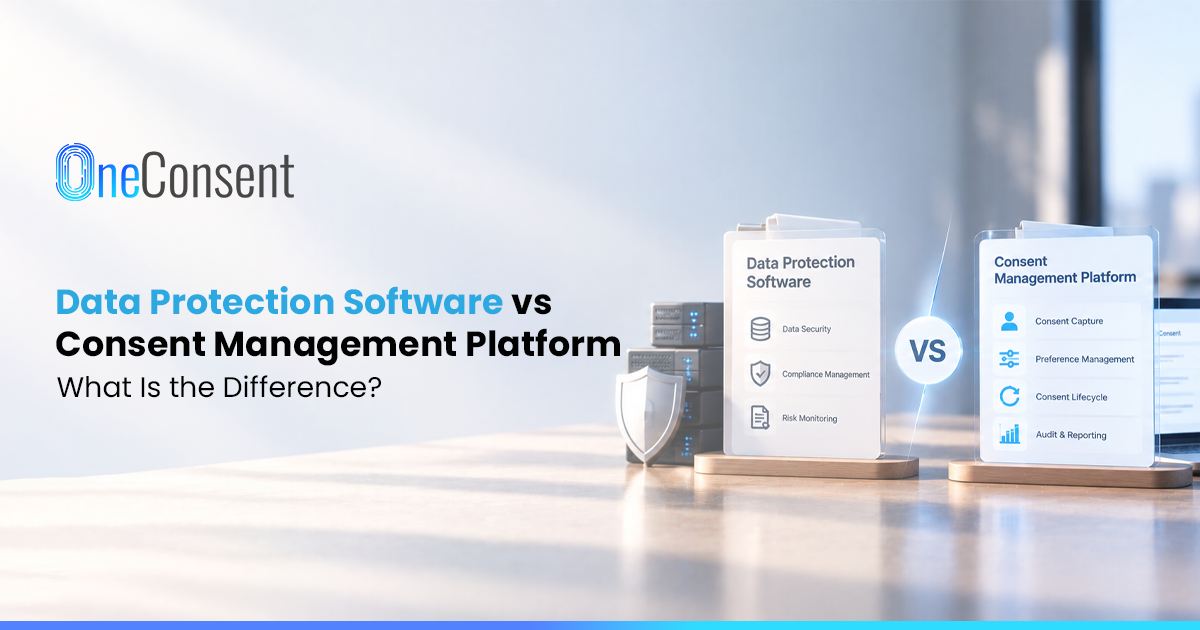
Most enterprises considering privacy tech for the DPDP Act look at data protection software and consent management platforms in the same group. (There's a reason for that: each one covers a separate part of the Act.) Recognising the data protection software vs consent management platform distinction early can save your enterprise a second procurement cycle. First, of course, is consent: where processing is based on consent, your enterprise has to show that a notice was issued and that the customer consented. (In most Indian enterprises, that evidence is stored in different ways by the CRM and the messaging systems they use, each maintaining a different opt-out list, so that evidence can only be offered if those lists agree at the time of the request.)
Your reachable audience for marketing activities that rely on consent consists of customers who have current, valid consent for the relevant purpose.
A withdrawal that never reaches the campaign tool can turn a routine festive offer into a complaint.
Data protection software is used to enable privacy governance throughout the organisation, from discovery of personal data to dealing with data breach issues. The consent management platform uses one lifecycle process that starts when the customer receives the notice and ends when the withdrawal is processed by all systems involved in using the data. There are many organisations that require both, and each is responsible for a specific set of tasks.
The DPDP Rules, 2025 establish a phased implementation timeline that will influence your implementation of the consent management platform. Rules 1, 2 and 17–21 came into force upon publication. Rule 4, covering Consent Managers, is scheduled to come into force on 13 November 2026. Rules 3, 5–16, 22 and 23 are scheduled to come into force on 13 May 2027.
What Is Data Protection Software?
Data protection software is a broad category of tools for governing personal data across its lifecycle, from discovery and mapping through to risk assessment and incident response. Vendors also market it as privacy management software or a privacy management platform.
Privacy and IT security teams are the primary users of these tools. Typically, they include a discovery module to scan databases and file shares, along with an inventory that tracks where different types of data are stored. Many also facilitate privacy impact assessments before new projects begin. Vendor risk management and breach response features are often offered as add-ons. Because the features included in these packages differ significantly between vendors, comparing prices is only useful after your privacy office and procurement team have established a clear list of required functionalities.
Without an accurate data map, it's difficult to implement appropriate security measures. This same data inventory is also helpful when investigating a data breach, though no specific product is mandated for either task. Following a personal data breach, the Data Fiduciary must notify the Data Protection Board without delay and inform affected individuals without delay. Detailed information must be provided to the Board within 72 hours of becoming aware of the breach, unless the Board allows a longer period on a written request. These breach-notification requirements are scheduled to take effect on 13 May 2027. Requests from individuals for access to or erasure of their data also rely on this inventory. Organisations identified as Significant Data Fiduciaries are subject to data protection impact assessments and audits, with assessment modules helping to manage this workload.
What Is a Consent Management Platform?
A consent management platform (CMP) presents users with a notice, records their consent preferences, and ensures that systems using their data adhere to those choices, including any changes made later. Its focus is more specific and detailed regarding a particular process. Some vendors use the term "consent management software" for this same type of product.
Marketing and CRM teams are the most frequent users of CMPs because these platforms control who can be contacted and how. Users interact with a CMP through website banners, app screens or consent prompts during checkout.
The platform logs each accepted purpose against its notice version. Take a customer who withdraws consent for promotional messages. Her record updates first, followed by the email and SMS tools. Through a preference centre, she can switch from SMS to email or hear from the brand less often, without calling support.
Most of the Act's requirements regarding consent can be managed within these systems. Each request for consent must include a notice, provided at the time of the request or just before it. This notice must clearly state what personal data is being collected and for what purpose. Withdrawing consent must be as straightforward as giving it. Rule 3 specifically requires the notice to explain the withdrawal process and is scheduled to take effect on 13 May 2027.
When consent is withdrawn, personal data processing based on that consent must stop within a reasonable time, unless processing without consent is required or authorised by law. Where processing is based on consent, the business must be able to demonstrate that it provided notice and received consent. While a consent management platform (CMP) can make this proof easier to access, the company itself is ultimately responsible for showing that it followed the rules.
Registered Consent Managers are a separate category: under the Act, a Consent Manager is a person registered with the Data Protection Board of India who acts as a single point of contact for individuals. Individuals use its platform to manage consent with onboarded businesses. By comparison, a CMP is software a business runs for its own customers.
Data Protection Software vs Consent Management Platform: Key Differences
When comparing data protection software with consent management platforms, most buyers first notice the difference in what each can do. A privacy team needing to find data and manage user rights has broader needs than a marketing team trying to keep consent consistent across websites, stores and campaign tools. The following points highlight how these two categories differ:
Scope: A privacy platform may cover discovery, assessments, rights requests and incident management across the organisation. A CMP concentrates on consent itself, from capture through each later change at customer touchpoints.
Consent: Many data protection suites record consent as the basis for processing a dataset. A CMP captures consent purpose by purpose at each touchpoint, with version history that legal teams can produce as evidence.
Data mapping: Discovery and inventory are core data protection features. A CMP's knowledge typically stops at which purposes each customer accepted, without mapping every table that stores that customer's data.
Privacy assessments: Impact assessments and vendor reviews are commonly supported by data protection software. Consent records from a CMP can serve as one of their inputs.
Data rights: Data protection software tends to manage full rights requests from intake to closure. A CMP handles consent withdrawals and preference changes, then passes them downstream.
Preferences and integrations: Preference centres and connectors to CRM, CDP and campaign tools are central to a CMP and usually secondary in data protection software.
The last point tends to settle the question for customer-facing businesses. Late consent updates can mean customers still get messages after they've opted out, an error that a customer complaint to the Data Protection Board could expose before an internal audit.
What's the Solution Your Business Requires?
Ultimately, whether a data protection platform or a consent management solution is the right fit for you depends on where the bulk of your data protection work is being carried out. For banking and insurance institutions, years of acquisitions and outsourced work have led to the adoption of complex systems and dozens of vendors. They also have a range of data, including call recordings, scanned passports and IDs, and branch system data that customer journey tools can't access.
For them, discovery comes first, and some could also be designated Significant Data Fiduciaries. Data protection software tends to lead their programme.
Retail and D2C brands face a different risk profile, concentrated at the point of consent in stores and apps where customers join loyalty programmes and change their communication choices often. Consent captured at a store counter needs to reach the CRM and downstream messaging systems before those systems are used for promotional communication. Travel brands face similar pressure because one booking can pass through an aggregator and the brand's app before reaching a call centre. For these businesses, a consent management platform addresses the daily risk first.
Enterprises running both need to design the integration deliberately. The CMP should hold the master record for consent and preferences. Your data protection platform should read those records instead of capturing consent itself. Settling ownership early prevents two versions of one customer's consent.
Buying committees can settle most of the decision with three questions:
Where do customers give consent today, and across how many channels?
Which systems must stop processing within hours of a withdrawal?
Who will produce consent evidence if a complaint reaches the Board?
How Consent Management Supports DPDP Compliance
DPDP consent management covers the duties that arise each time a customer shares personal data and the processing relies on consent. Several of them move from spreadsheet tasks to routine system behaviour once a CMP is in place. The itemised notice appears before or alongside the consent request. Customers then see the same purposes the business records. Each consent action enters a tamper-evident trail that legal teams can retrieve.
Withdrawal works through the channel where the customer gave consent. That design supports the Act's requirement that withdrawing should be as easy as consenting. From there, the withdrawal reaches connected systems, sparing marketing operations a weekly reconciliation of opt-out lists across messaging tools.
Whether a purpose is lawful and whether a field is necessary remain questions for the business and its lawyers. Once a purpose has been approved, a CMP helps apply that decision in the same way at every touchpoint.
What to Look for in a Consent Management Platform
Test plans built from your own journeys make shortlisting DPDP compliance companies easier. Six checks cover most shortlists:
Customers give and withdraw consent per purpose, with the notice version stored against each record.
One consent model covers web and app journeys, plus stores and WhatsApp.
Records show who agreed to what and under which notice, in a form legal teams can export for a proceeding.
Withdrawals reach downstream tools through APIs, with each update logged.
Customers update preferences themselves, without a support ticket.
Notices work in Indian languages: under the Act, customers must have the option of reading the notice in English or any language listed in the Eighth Schedule to the Constitution.
Running a short pilot often reveals more than a feature sheet. Record a withdrawal on one channel, then time how long the CRM and the WhatsApp provider take to reflect it.
Related Reading: Consent Management Platform in India: A Buyer's Guide
How OneConsent Approaches DPDP Consent Management
For organisations whose immediate requirement is customer consent, as opposed to enterprise-wide privacy management, a CMP can be introduced as a focused layer alongside existing privacy technology. OneConsent is one such consent management platform, designed around DPDP requirements for customer-facing enterprises. It captures consent purpose by purpose against versioned notices, across digital journeys and at the POS, including messaging flows such as WhatsApp opt-in. OneConsent is designed to store each consent action with its notice version. Legal and compliance teams can retrieve that trail on request. Preference changes can sync to the connected CRM and marketing stack.
Enterprises already running broader data protection software can use OneConsent as the consent system of record that feeds it. Brands starting from customer journey risk get a focused DPDP compliance platform shared by marketing and privacy teams. Teams comparing DPDP compliance software in India can apply the six checks above to OneConsent as they would to any other vendor.
Matching Each DPDP Obligation to the Right Tool
Choosing a DPDP compliance solution starts with listing your obligations and assigning each one to a system and an owner. Consent and notice duties point to a CMP. Discovery and breach response belong with data protection software. Organisations using DPDP consulting for a readiness assessment can hand that list to their advisers as a starting brief. Buyers who need both should test the integration as hard as the features, starting with how a withdrawal recorded in the CMP appears in the data protection platform's inventory. You can explore the OneConsent platform to see purpose-based consent and preference synchronisation at work. To map your own customer journeys against DPDP consent requirements, book a personalised demo with our specialists.
Frequently Asked Questions
Have more questions?
Search our full DPDP knowledge base for more answers.