DPDP Companies in India: Types and How to Choose
Compare DPDP companies in India by service type, capabilities and business needs. Learn how to evaluate consultants, compliance software and consent platforms.
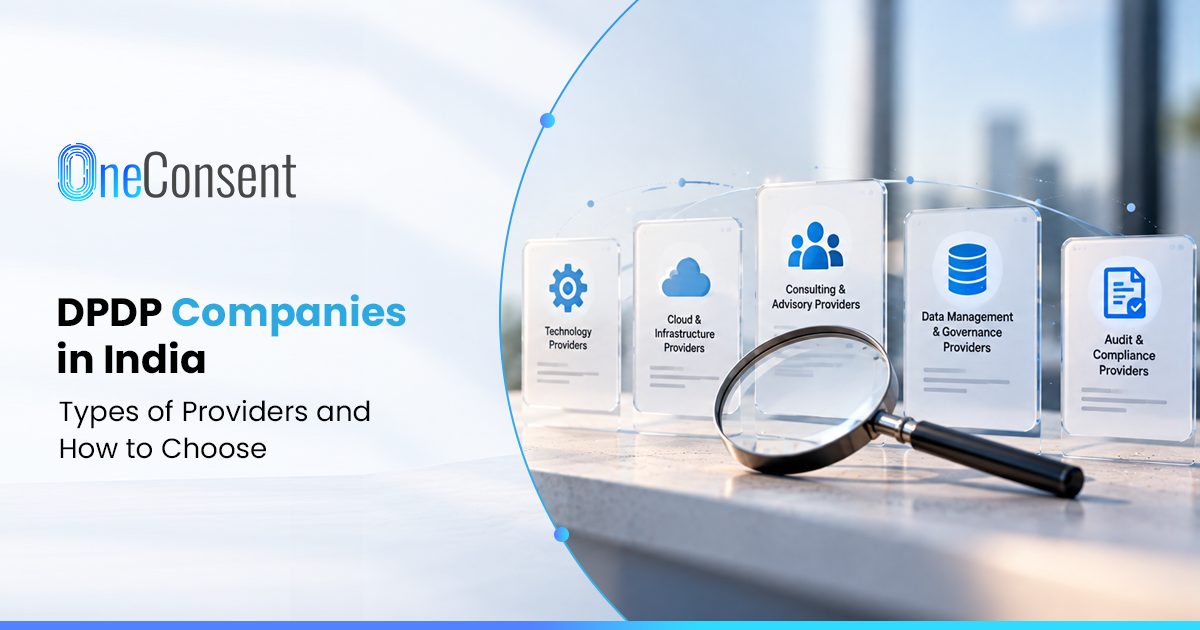
Businesses are searching for DPDP companies in India because the Digital Personal Data Protection Act, 2023 (the Act) and the DPDP Rules, 2025 create work for several teams at once. Most organisations face three needs: understanding which obligations apply to each process, putting those obligations into practice across teams and keeping evidence of how each process operates. Evidence includes the notice a customer saw and the way the team closed a request.
DPDP companies are service providers that help with these needs. Consultants and law firms advise on obligations, while software vendors run recurring workflows and keep records. Implementation partners carry out the rollout. Your choice of provider type shapes how much the project costs and how much internal effort it takes.
You will find eight provider types in three groups below, along with six tests for vendor claims and an explanation of how a consent management platform differs from a registered Consent Manager.
What DPDP Companies in India Do for Your Business
Sequence matters across the three needs, and the order decides what a business buys first. Obligations come first because teams and software follow them. Evidence needs early design even though its tools are often bought last. Consent records hold up best when the system captures them at the moment of consent. A record rebuilt later from emails and spreadsheets carries less weight. Few systems and a small customer base may let a business meet its early needs with advice and a documented manual process. Many systems and channels call for software that keeps records consistent.
Provisions of the Act and Rules start in stages. A plan needs to separate those in force from those that begin later:
13 November 2025: the Government notified the DPDP Rules, 2025 (G.S.R. 846(E)). Rules 1, 2 and 17 to 21 took effect on Gazette publication and cover definitions and the Data Protection Board.
13 November 2026: Rule 4 on Consent Manager registration starts one year after Gazette publication.
13 May 2027: Rules 3, 5 to 16, 22 and 23 start eighteen months after Gazette publication. Privacy notices and security safeguards fall in this group, along with the rules on breach reporting and customer rights.
Under the Schedule to the Act, failure to take reasonable security safeguards against a personal data breach carries a maximum of ₹250 crore. Other duties carry lower maximums, and each maximum applies once its duty is in force.
Types of DPDP Companies in India: Which Provider Does Your Business Need?
Neither the Act nor the Rules classify service providers, so the market has no official list. DPDP companies in India fall into eight types that cover the services businesses buy. Each entry below names a primary capability, since one company may offer several services.
Advisory and legal
DPDP consulting, advisory and audit firms suit a business that has not yet decided which gaps to address or who should own them. A useful readiness assessment ends with a ranked gap list and a named owner for each fix. An audit reviews the controls already in place and reports findings against the Act. The Central Government notifies a category called Significant Data Fiduciary, and its members must appoint an independent data auditor. Other businesses can commission an audit by choice, and an auditor adds the most value when it did not design or implement the controls under review.
Privacy law firms answer questions that need a legal opinion. Examples include how the Act applies to a particular business and what a vendor contract should say.
Technology
DPDP compliance software and privacy management platforms give several teams one shared system for compliance tasks and the evidence they produce. Ask which duties it supports and which stay with your team.
Consent management platform providers manage the full consent lifecycle, from the notice a customer sees to a later withdrawal. A consent dashboard can show that a customer withdrew consent. Marketing teams also need to know which connected systems received the change and whether messages stopped.
Data discovery and classification providers search databases and applications for personal data and show where it travels, including to vendors. IT teams receive an inventory of where customer data is stored. Its value lasts only while the inventory stays complete and current, so ask who maintains it after the first scan.
Specialist privacy technology providers focus on a single capability, such as handling rights requests or tracking third party risk. They suit a business that already has a wider process and needs one gap filled.
Execution and security
Cybersecurity and data protection companies secure the systems that hold personal data and respond to incidents. Some security vendors do not sell a DPDP specific service. Ask which of their tools help meet the duty to take reasonable security safeguards.
Implementation and managed service providers help when an organisation knows which controls it needs and lacks the people to put them in place. They coordinate the rollout with internal teams, and some stay on to run the process. Confirm how much internal time and system access your own staff must provide.
Which Team Owns Which Provider Decision
Vendor conversations move faster when four teams have a named owner. Legal and compliance assigns one owner to interpret the Act and another to approve privacy notices. IT and data engineering prepares a list of the systems that store personal data and those that receive it. Data discovery tools can build and refresh that list. Customer service gives each rights request and complaint a named owner and a due date, and compliance software with workflow features can track both.
Procurement confirms that each vendor processing personal data for the business has a valid contract. The Act calls the business the Data Fiduciary and a vendor that processes data on its behalf the Data Processor. Responsibility for that processing stays with the Data Fiduciary. The Act allows a Data Processor to be engaged only under a valid contract. Third party risk tools can help track these contracts.
Consent Management Platform and Registered Consent Manager
A consent management platform is software that a business uses to manage consent from its own customers. Separate from that software, a registered Consent Manager is a role that Section 2(g) of the Act defines as a person registered with the Data Protection Board of India. An individual, called the Data Principal in the Act, can use a Consent Manager as a single point of contact to give, review and withdraw consent through an accessible, transparent and interoperable platform.
A business can use or offer consent management software without registering as a Consent Manager. The Act lets the individual choose whether to use a Consent Manager. Rule 4 governs registration and the obligations of a Consent Manager. Part A of the First Schedule lists the conditions an applicant must meet. Check the Board's website for current registrations before you call any provider a registered Consent Manager. If a vendor says the Rules require integration with one, ask for the Rule text it relies on.
How to Evaluate DPDP Compliance Service Providers
Test the claims of DPDP companies in India in six areas before you choose:
Scope and duties. Ask the provider to name each duty its service supports and the evidence it produces, then give every duty that stays with your team an owner. Find out which services its own staff deliver and which come through partners.
Integration and enforcement. Connector lists say little about enforcement, so ask the vendor to run a consent withdrawal in a test environment. Check whether the change reaches your CRM and messaging tools, how long it takes and what the system records if an integration fails.
Consent evidence. Ask for a sample consent record that shows the notice version the customer saw and the purpose of consent. It should also carry the time of consent and any later withdrawal. Where consent is the basis for processing, the Act places the burden on the Data Fiduciary to prove that notice was given and consent obtained. A sample record therefore carries weight in a proceeding.
Rights handling. Ask the provider to walk through one request from receipt to closure. Look for who receives the request, how deadlines are tracked and what happens when one is missed.
Security and contracts. Because the provider will hold your customers' data, request its independent audit reports and incident response procedure. Rule 6 starts in May 2027 and calls for appropriate contract provisions on reasonable security safeguards where applicable. Check whether the provider helps your team track processor agreements.
Delivery and cost. Ask for a project timeline and the list of staff you must provide, plus the support offered after launch. Put each quote into one sheet that separates licence fees from implementation and support costs. Two quotes may cover different work, so compare them line by line. Finish with a reference call to a similar customer.
DPDP Compliance Needs by Industry
Needs differ by operating model, and qualified counsel can confirm which obligations apply to a given business. BFSI firms handle consent in onboarding, lending and collections. Sector regulator directions can apply alongside the Act to the same process. Retail and e-commerce brands collect consent on websites and apps, at store counters and during loyalty sign up, so all channels should update one customer record.
Healthcare providers hold patient records, so hospitals and clinics need clear notices and a route for patient requests. SaaS companies that process data for enterprise customers can act as Data Processors, which brings processor terms into their contracts. D2C brands can let customers change communication preferences at sign up and at repeat purchase.
How OneConsent Supports Consent Records, Data Visibility and Rights Requests
OneConsent brings consent management together with data discovery and privacy workflows that support DPDP implementation. Marketing and product teams use notice creation and management, consent preference management and the consent audit trail to create notices and record consent. IT and compliance teams use data discovery and the gap assessment module to find where customer data is stored and which gaps need attention. Customer service and procurement teams use data principal rights and third party risk management to track requests and vendor contracts. The platform also includes modules for DPIA and RoPA, along with breach management.
A Significant Data Fiduciary must carry out a Data Protection Impact Assessment at regular intervals, and other organisations can adopt the assessment by choice. Global privacy frameworks introduced the record of processing activities, and the Act does not name it as a requirement. OneConsent can support privacy workflows and the evidence they produce. Responsibility for decisions and legal obligations stays with the business. Consent Manager status under Rule 4 is a separate registration with the Board.
Read the OneConsent DPDP compliance guide
Make Your Company DPDP-Compliant with OneConsent
If your organisation is comparing DPDP companies in India, a consulting session can map your consent and rights workflows to the provider types in this guide. The OneConsent team reviews current processes and identifies which needs a platform can address and which need advisory or legal support. You then receive personalised findings for your vendor evaluation. To begin, explore the OneConsent platform or book a personalised demo.
Rohit Sharma is a Marketing Manager at OneConsent with over 7 years of experience across digital marketing, and digital transformation. His work spans content research, planning, and marketing, with a focus on DPDP compliance, data protection, privacy, AI, and emerging technologies. At OneConsent, he focuses on researching and writing about data privacy, consent management, and the DPDP Act, making complex topics clear, practical, and relevant for businesses while helping audiences understand how privacy and technology are shaping the future of digital experiences.
See all articles by Rohit SharmaFrequently Asked Questions
Have more questions?
Search our full DPDP knowledge base for more answers.