DPDP Compliance for F&B Brands: A Practical Guide to Consent Management
How F&B brands can build purpose-specific, audit-ready consent across ordering, loyalty, and delivery.
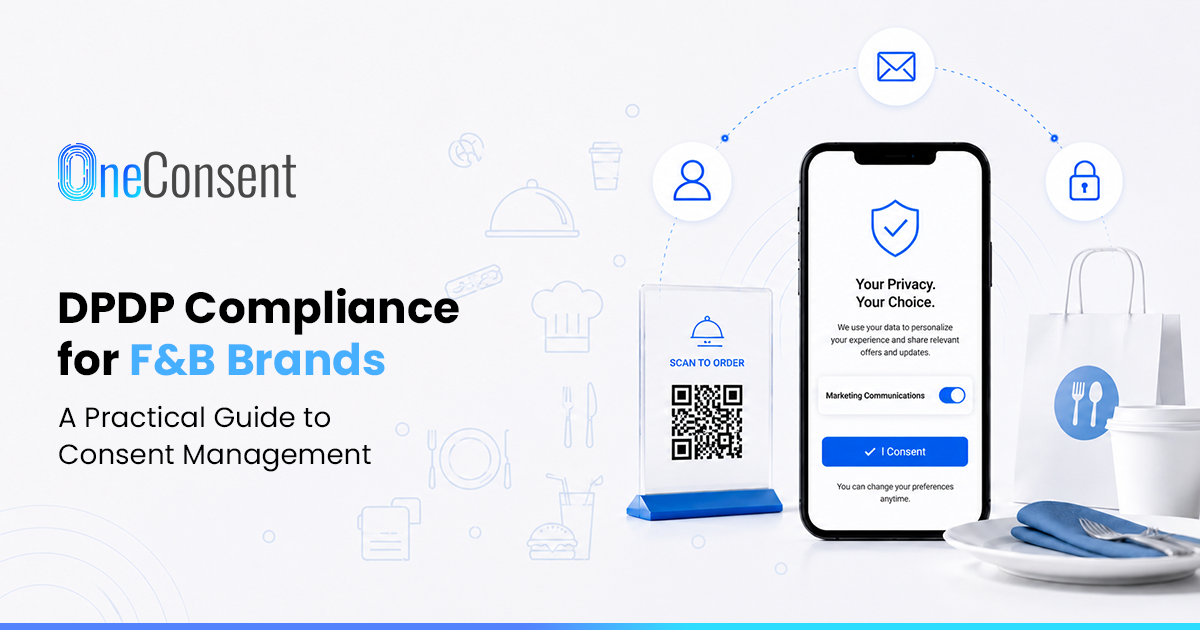
Most F&B Brands Collect Customer Data, But Very Few Are DPDP-Compliant
Whether you run a single café, a QSR chain, a cloud kitchen, or a multi-city catering business, if you're collecting phone numbers for orders, running loyalty programs, or sending promotional messages, you're already handling personal data under India's Digital Personal Data Protection (DPDP) Act, 2023.
The problem: most F&B brands don't have provable, purpose-specific consent for any of it.
In practice, that means:
Failed audits when consent proof is asked for
Customer complaints you can't defend
Regulatory exposure, with penalties that can run into hundreds of crores per violation
Reputational damage that's hard to undo, at a scale that grows with every outlet you add
This blog covers where F&B brands typically go wrong, what DPDP actually requires, and how to fix consent compliance without disrupting operations, using a consent layer like OneConsent.
Why DPDP Is a Real Risk for F&B Brands
F&B leaders don't usually think of their business as a data business. But the moment a phone number is collected for order updates, an email for billing or offers, or purchase history for loyalty, the brand becomes a Data Fiduciary under DPDP, regardless of whether it runs one outlet or two hundred.
Regulators don't ask whether you have a privacy policy on file. They ask:
When was consent taken?
For what purpose?
Can you prove it?
For growing F&B brands, the answer is often scattered across POS systems, loyalty engines, delivery integrations, and marketing tools that were never built to talk to each other, and that fragmentation is exactly where the compliance risk sits.
Where F&B Brands Collect Data, And Why Each Needs Separate Consent
Across dine-in, QSR, cloud kitchens, and catering, F&B brands typically collect personal data across six touchpoints:
Signup, login, and reservations
QR code and digital ordering
Loyalty programs and customer profiling
Delivery aggregator integrations (Zomato, Swiggy, etc.)
Food delivery and rider/customer location data
Marketing communication (SMS, WhatsApp, email)
Each is a separate purpose under DPDP - consent for one doesn't cover the others, and this applies whether the brand runs a single outlet or a national chain.
DPDP Consent for Signup, Login, and Reservations
What data is collected: Mobile number, email, name.
Where brands go wrong: Consent is implied by usage, hidden inside terms and conditions, or not recorded in any retrievable format. This creates immediate audit risk,and the risk compounds with every outlet or franchise location using its own signup flow.
What DPDP requires: Before signup or reservation is completed, the customer must see why their data is being collected, and consent must be explicit and purpose-specific.
How OneConsent helps: Captures consent before data collection, links it to a clear purpose, and logs it automatically with a timestamp, consistently across every outlet.
Business impact: Lower audit risk, no engineering rework later, clear proof if consent is challenged.
DPDP Compliance for QR Code and Digital Ordering
This is one of the highest-risk, most overlooked consent gaps in F&B today, and it scales fast for multi-outlet brands.
Data collected: Mobile number, order details, table or outlet identifier, sometimes preferences.
The risk: Brands assume that placing an order implies consent for everything downstream. Under DPDP, that assumption doesn't hold, and it doesn't get safer just because the same flow is replicated across every location.
What DPDP requires: Consent must separately cover order processing, storage of customer details, and any optional use like analytics.
How OneConsent helps: Shows contextual consent notices during digital ordering, captures consent before the order is placed, and stores it centrally instead of scattered across outlet-level POS systems.
Business impact: No silent consent gaps, a protected digital ordering journey, and simplified compliance across outlets and formats.
Consent for Loyalty Programs and Repeat Customers
Loyalty programs involve profiling, a separate purpose under DPDP, and often the centrepiece of an F&B brand's customer strategy.
Data used: Phone number, visit frequency, purchase history.
Common mistake: Auto-enrolling customers into loyalty using data collected for something else, like billing, a pattern that's especially common when loyalty is rolled out chain-wide after outlets have already been collecting data independently.
What DPDP requires: Separate, explicit consent for loyalty participation, with the option to decline without affecting service.
How OneConsent helps: Collects standalone consent for loyalty programs, maps it clearly to profiling purposes, and maintains long-term consent history across the brand's full outlet network.
Business impact: Safer retention strategies, no misuse of transactional data, a strong position in audits.
Consent for Delivery Aggregator Integrations
Data shared: Name, phone number, delivery address, passed from Zomato, Swiggy, or similar platforms to fulfil the order.
The risk: This makes the receiving brand a Data Processor for that data. Using it beyond order fulfilment for the brand's own marketing, for instance, isn't automatically covered.
What DPDP requires: A clear boundary on use, ideally backed by a Data Processing Agreement with the aggregator, so aggregator-sourced data doesn't silently become a house marketing list.
How OneConsent helps: Keeps aggregator-sourced customer data flagged separately from house-collected data, so it's never pulled into a campaign without the right consent basis.
Business impact: No accidental cross-use of processor data, cleaner separation between channels, fewer disputes with aggregator partners.
Marketing Consent for F&B Brands (SMS & Email)
Promotions drive repeat business, but only when done lawfully, and the exposure scales with the size of the customer database.
Channels: SMS offers, festival promotions, discount campaigns, email newsletters.
High-risk area: Using phone numbers collected for ordering or billing to send promotions, a shortcut that's tempting precisely because it's easy to do at scale.
What DPDP requires: Separate, explicit opt-in for marketing, clearly distinct from service-related communication.
How OneConsent helps: Independent marketing consent capture, clear opt-in/opt-out tracking, and real-time enforcement so campaigns check consent before every send.
Business impact: Reduced complaint risk, cleaner customer lists, safer marketing operations at scale.
DPDP for Food Delivery and Cloud Kitchens
Food delivery is its own risk category under DPDP, distinct from the aggregator-data question above, because delivery-first brands (aggregators, cloud kitchens, and any F&B brand running in-house delivery) handle a wider and more sensitive mix of personal data than dine-in alone.
What's different about delivery data:
Real-time location: Both the customer's delivery address and, for anyone running their own delivery fleet, the rider's live location while on a job
Eating habit profiling: Order history reveals dietary patterns, health-adjacent inferences (e.g., diabetic-friendly orders, weight-loss meal plans), and frequency data that's more sensitive than a one-off dine-in visit
Multiple Data Principals in one flow: A single delivery involves the customer, the brand, and (where applicable) the rider, each with independent rights under DPDP
Where brands go wrong:
Using order history to build personalisation or recommendation profiles without disclosing that profiling in the privacy notice
Treating rider location tracking as purely an operational/HR matter rather than personal data processing that riders themselves have rights over
Not stopping location tracking when a rider is off-duty
Assuming that because a brand only receives customer data to fulfil an order, no further compliance obligation applies to either side
What DPDP requires:
Personalised suggestions based on order history are permitted, but only if the privacy notice clearly discloses this profiling, and if a customer withdraws marketing consent, personalised recommendations should stop even while ordering itself continues
Rider location data requires the same transparency and purpose-limitation standard as customer data: riders need to be told exactly how tracking works, and tracking shouldn't continue outside working hours
Where a brand receives customer name and address from a delivery platform purely to fulfil an order, that relationship should be governed by a clear agreement preventing repurposing for independent marketing
Where OneConsent plays a role
OneConsent distinguishes consent by purpose across the delivery flow, order fulfilment, personalisation/profiling, and marketing are tracked separately, so a brand can keep sending order updates to a customer who's opted out of promotional profiling, without the two getting tangled in one blanket consent record.
Business impact: Defensible personalisation, cleaner handling of multi-party delivery data, and fewer grey areas if a customer or rider raises a grievance.
What Happens If F&B Brands Ignore DPDP?
Serious non-compliance can attract penalties running into hundreds of crores per violation
Repeated violations increase regulatory scrutiny, and for multi-outlet or franchise brands, that scrutiny doesn't stay contained to a single location
Customer trust, once lost, is hard to rebuild, particularly for brands whose growth depends on repeat visits and loyalty
Consent gaps are easy to miss and expensive to fix later, and the cost of fixing them only grows as the brand scales.
Why F&B Brands Need a Central Consent Layer
F&B brands run on multiple systems - POS, digital ordering, CRM, loyalty, marketing tools, often duplicated across outlets, franchises, and delivery channels. OneConsent acts as a central consent layer that standardises consent across all of them, maintains audit-ready logs, and reduces legal, operational, and reputational risk, without requiring a brand to rip out and replace what's already running.
Key Takeaways for F&B Industry Leaders
DPDP applies to any F&B brand collecting customer data, regardless of size or format
Consent must be purpose-specific and provable, not implied
Digital ordering, aggregator data, and marketing are the biggest risk areas
Delivery-first and multi-outlet models introduce additional complexity, rider data, franchise-level fragmentation, and cross-outlet consent propagation
Penalties for non-compliance are severe and scale with the size of the customer base
A central consent layer simplifies all of it, across every outlet and channel
Get Consent Right, Everywhere Your Guests Are
The F&B brands that get consent right aren't just avoiding penalties, they're building customer relationships they can actually trust and market to, without second-guessing every campaign. If your loyalty program, digital ordering, or delivery data isn't backed by purpose-specific, provable consent yet, now is the moment to fix that. Book a demo to see how OneConsent fits into your existing POS, loyalty, and ordering stack, without disrupting how your outlets already run.
Frequently Asked Questions
Have more questions?
Search our full DPDP knowledge base for more answers.