DPDPA Compliance Software India: Build vs. Buy, What Enterprises Should Consider
Should enterprises build DPDPA compliance infrastructure in-house or buy a specialised platform? Explore the build, buy, and hybrid approaches across cost, integrations, control, scalability, and ongoing compliance requirements.
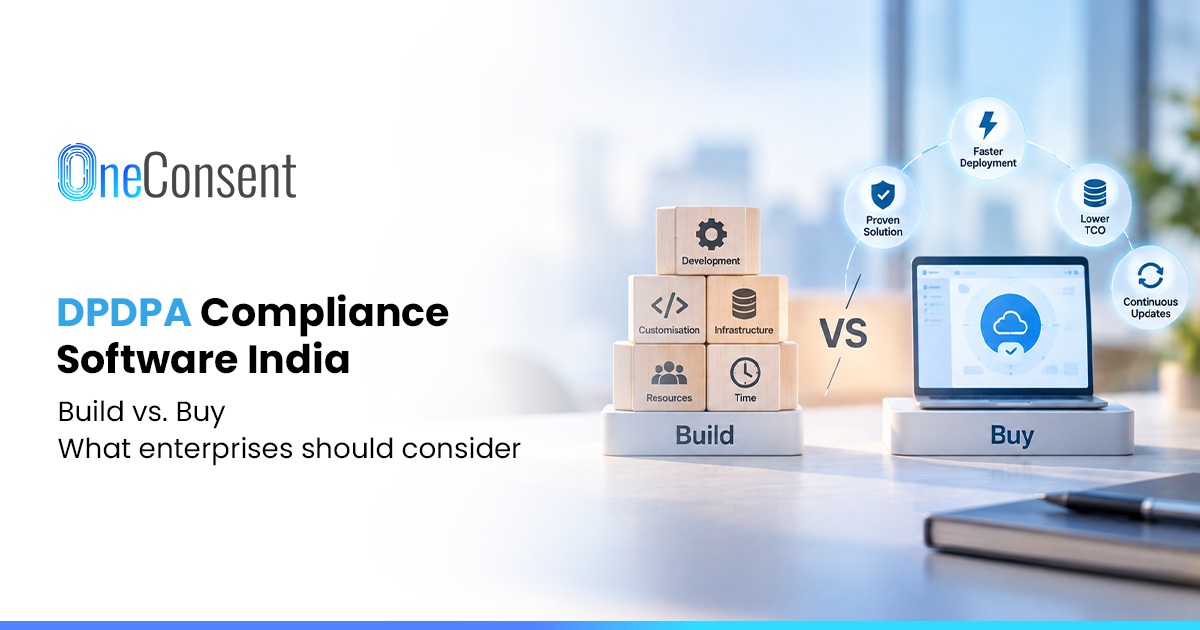
An enterprise preparing for the Digital Personal Data Protection Act runs into an architectural question early in the process: build compliance infrastructure internally, or adopt a specialised platform. The decision reaches across legal, compliance, technology, marketing, and data teams, since a DPDP compliance solution may need to support notices, consent capture, withdrawal, Data Principal rights, evidence, and system integrations across a complex enterprise environment.
There is no universal answer to the build-versus-buy question. The right model depends on the organisation's technology stack, customer journeys, processing activities, internal engineering capacity, and governance model. The more useful question for enterprise leaders is which parts of DPDP compliance the organisation should own, and which capabilities are better supported by specialised infrastructure. That distinction creates a better foundation for evaluating DPDPA compliance software in India than a straight cost comparison does.
What DPDPA Compliance Software Needs to Support
DPDPA compliance software provides the operational layer through which an organisation manages privacy and data governance workflows under the Digital Personal Data Protection Act, 2023 and the DPDP Rules, 2025. For consent specifically, Section 6 requires consent to be free, specific, informed, unconditional, and unambiguous, with clear affirmative action, and a Data Principal must be able to withdraw consent with ease comparable to the process used to give it. The final DPDP Rules add operational detail to this: Rule 3 requires notices to provide an itemised description of personal data and the specified purpose of processing, alongside a clear way to access withdrawal and rights mechanisms.
This means the technology question runs well past displaying a consent form. Depending on your scope, a DPDPA compliance platform typically needs to cover four connected areas: notice and consent itself, including purpose management, notice versioning, and purpose-based capture; the Data Principal-facing layer, covering preference management, rights requests, and grievance handling; evidence and governance, covering consent records, audit trails, and compliance monitoring; and the technical layer tying the other three together, covering system integrations and consent synchronisation across every connected application.
For your enterprise, these capabilities may need to span websites, mobile apps, CRM, point of sale, contact centres, WhatsApp, loyalty systems, and marketing platforms at once. This breadth is why DPDPA compliance software deserves evaluation as enterprise infrastructure, and not as a standalone compliance widget.
OneConsent's guide on what a consent management platform is under DPDP covers this in more depth.
Build, Buy, or a Hybrid Architecture
A build strategy means the enterprise designs, develops, and operates the required privacy and consent capabilities inside its own technology environment. A buy strategy uses a specialised consent management platform and integrates it with existing enterprise systems. A third model falls between these two: a hybrid architecture, where the organisation retains certain internal workflows and systems while using specialised software for consent capture, evidence, preference management, withdrawal orchestration, or rights management specifically. The evaluation that follows treats build, buy, and hybrid as three genuine architectural options in their own right.
When Building Makes Sense
Building tends to make sense where privacy infrastructure needs to be embedded deeply inside proprietary systems, and where the organisation has the engineering capacity to maintain that infrastructure on an ongoing basis, after the initial build is complete.
The strongest case is a deeply customised technology environment. Some enterprises run proprietary customer, transaction, or identity infrastructure that cannot easily be replaced, and building selected components internally can give precise control over how consent status interacts with existing business logic. A closely related case is a product where privacy rules are built directly into the application itself, so consent and processing decisions stay tightly bound to that proprietary logic instead of living in a separate layer.
Either case only holds up with dedicated privacy engineering capacity behind it. Building a consent database is one task; running an enterprise privacy system on an ongoing basis means managing purposes, notices, consent versions, APIs, identity resolution, withdrawal propagation, audit records, and access controls indefinitely, not as a one-time project. Some organisations also have a strategic requirement for internal control, driven by deployment model, data residency, or security architecture preferences.
What to Calculate Before Choosing to Build
The business case for internal development should rest on total cost of ownership, not development cost alone. Worth working through before you commit: the engineering time the design, build, and integration work will require; how many systems, from CRM to POS to marketing automation, need to consume or update privacy signals; who on your team owns translating changing regulatory requirements into product requirements on an ongoing basis; who manages day-to-day operations such as notice changes and customer requests once live; and whether you can reconstruct the full history of a consent event on demand, including who gave it, what purpose was presented, which notice version was shown, and whether it was later withdrawn.
Often the most relevant question for a CTO is opportunity cost: which planned engineering projects will compete for the same developers, security engineers, and architects that a build project would absorb.
When Buying a Platform Makes Sense
Buying becomes attractive when the goal is a dedicated compliance layer that integrates with the existing stack instead of becoming yet another part of it to maintain. Current DPDPA compliance software in India is increasingly positioned around consent, rights management, governance, retention, and audit evidence, covering far more than a single website consent widget, and several conditions make this approach worth evaluating seriously.
The first is that enterprise consent rarely originates from one interface; it may be captured through websites, apps, stores, branches, call centres, WhatsApp, CRM, loyalty programmes, and customer portals, and a dedicated platform gives these signals a central home instead of scattering them across each collecting system. The second is that many systems, not only the one that captured it, depend on consent status. A customer who withdraws marketing consent expects that choice to affect campaign execution across email, SMS, and WhatsApp alike, so consent status needs to move with the customer's choices across every connected system, instead of staying fixed wherever it was first recorded.
The third is centralised evidence. A consent record becomes consistently useful when it preserves context alongside the bare fact of consent, such as identity, purpose, timestamp, source channel, notice version, and withdrawal history, so legal and compliance teams can answer a question without reconstructing records from several applications by hand. The fourth is that regulatory updates should not become fresh engineering projects each time. The DPDP Rules follow a phased commencement: Rule 4 comes into force one year after the 13 November 2025 Gazette publication, while Rules 3, 5 to 16, 22, and 23 come into force eighteen months after that date. With specialised software, a meaningful share of that ongoing maintenance shifts to the platform provider, though legal interpretation, governance decisions, and compliance obligations remain the organisation's own. Software can operationalise compliance processes; accountability stays with the organisation regardless of which model it chooses.
The Hybrid Model in Practice
For many large organisations, the strongest architecture combines internal systems with a dedicated consent layer instead of choosing one model exclusively. Ownership of the CRM, customer identity systems, CDP, transaction systems, marketing platforms, data warehouse, and internal governance processes stays in-house, while a specialised consent layer manages the relevant privacy signals and workflows across those systems.
The architecture, in practice, moves in two directions. Forward, a customer touchpoint reaches the consent layer, which informs enterprise systems and shapes processing and communication. Backward, a Data Principal's choice updates the consent record, which updates consent status, which then propagates to every connected system. This approach preserves the existing technology investment while introducing a central governance layer for consent and preferences, instead of asking every existing system to individually become DPDPA-aware.
A Practical Framework: Questions to Ask Before Deciding
A useful decision framework focuses on operating requirements ahead of a feature checklist. Five questions carry the most weight in practice.
Map system exposure. Identify how many systems process customer personal data, since this shapes the integration architecture a platform would need.
Map collection channels. Count how many channels collect consent, since web, app, POS, branches, and messaging platforms often need different collection experiences feeding one consistent record.
Assess change frequency. Establish how often purposes and notices change, since frequent change raises the ongoing cost of custom workflows.
Assess propagation speed. Determine how quickly a withdrawal needs to reach every system relying on that consent.
Run the total cost comparison. Work out the realistic three-to-five-year total cost of ownership, comparing build costs such as engineering, infrastructure, integrations, security, and regulatory maintenance against buy costs such as licensing, implementation, configuration, and vendor governance.
What to Look For in a Platform
A platform evaluation should start from business requirements and regulatory workflows, not a vendor's feature list. Five capabilities are worth testing directly.
Purpose configuration. Confirm that different processing purposes can be configured and managed independently.
Channel consistency. Confirm that consent can be captured consistently across every channel you operate.
Accessible evidence. Confirm that the system maintains an accessible, exportable history of consent activity the internal team can query directly, rather than a log only the vendor can access.
Withdrawal reach. Confirm that a Data Principal can withdraw consent through an accessible process, and that the change reaches every connected system, including systems other than the one where the withdrawal was raised.
Notice linkage and rights handling. Confirm that notices and their versions stay linked to the consent collected against them, and that the platform can receive, route, track, and resolve Data Principal rights requests while connecting cleanly with your CRM, CDP, and marketing automation, at a security and scale level suited to your actual customer and consent volumes.
OneConsent has a dedicated guide covering the design of a DPDPA-compliant consent notice that goes into this in more depth.
Consent Manager Versus Consent Management Platform
These two terms describe different things and should not be used interchangeably in a procurement conversation. A Consent Manager, under the DPDP framework, is a specific statutory entity registered with the Data Protection Board, with registration and operating requirements set out under Rule 4 and the First Schedule of the DPDP Rules. A Consent Management Platform is enterprise technology an organisation uses to manage consent and related workflows for its own operations.
Most enterprises evaluating DPDPA compliance software in India are evaluating technology for internal use, and are not seeking to become a registered Consent Manager themselves. Keeping this distinction clear early prevents procurement conversations from getting tangled between two distinct concepts.
Where OneConsent Fits
Once you have mapped your purposes, customer touchpoints, systems, and governance requirements, technology provides the operating layer connecting those decisions. OneConsent is built as a consent management platform for Indian enterprises, covering consent and preference management, consent lifecycle management, consent evidence and audit trails, consent synchronisation across connected systems, notice management, and Data Principal request workflows.
For your enterprise, this means your existing CRM, CDP, POS, and marketing systems can stay part of the technology environment while a dedicated consent layer manages the relevant signals and governance workflows across them. A platform ought to fit the operating model already in place, instead of the operating model being redesigned to accommodate the platform.
The Enterprise Decision
There is no single architecture that fits every enterprise. The strongest decision weighs control, integration complexity, time to operationalise, ongoing ownership, and total cost together, not any one factor alone. DPDPA compliance software should support the organisation's broader data governance model, instead of operating as an isolated tool bolted onto the side of it.
A Practical Next Step
If your organisation is early in this evaluation, a useful starting point is running the five framework questions above against your current technology stack and mapping where the honest answer points toward building, buying, or a hybrid model.
Visit OneConsent to explore the platform in more detail. Book a demo to see how a consent management platform would fit alongside your existing CRM, CDP, and marketing systems.
Frequently Asked Questions
Have more questions?
Search our full DPDP knowledge base for more answers.