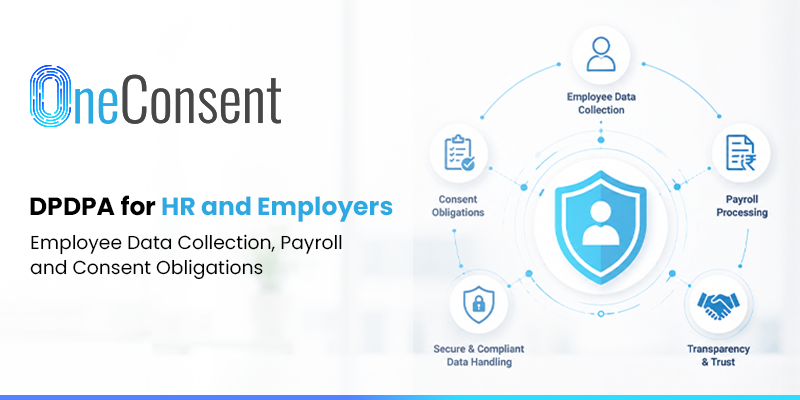
DPDPA for HR and Employers: Employee Data Collection, Payroll and Consent Obligations
Employers collect enormous amounts of personal data about their employees — often without the kind of consent and transparency framework that DPDPA now requires.
Most compliance conversations around DPDPA focus on customers. Marketing consent, checkout data, loyalty programmes. But walk into any HR department and you'll find a parallel data operation running quietly in the background, one that touches salary details, performance reviews, disciplinary records, health information, biometric attendance logs, bank account numbers, and government identification documents. DPDPA 2023 applies to employee data exactly as it applies to customer data, and most HR functions right now are simply not set up for that reality. There's an assumption, understandable but wrong, that an employment contract somehow covers everything an organisation might want to do with an employee's personal information. It doesn't.
What Employee Data Actually Falls Under DPDPA
It's worth listing this out because the scope is wider than most HR teams initially assume. Job application data such as CVs, educational certificates, and references. Onboarding data including Aadhaar, PAN, bank account details, and address proof. Payroll data covering salary, tax details, and deductions. Attendance and leave records, including biometric data. Performance management data. Health and insurance information. Disciplinary and termination records. And communication records, including emails and calls in environments where monitoring is in place. All of this is personal data under DPDPA, regardless of whether it sits in an HRMS, a spreadsheet, or a filing cabinet that hasn't been digitised yet.
Where the Employment Contract Covers You, and Where It Doesn't
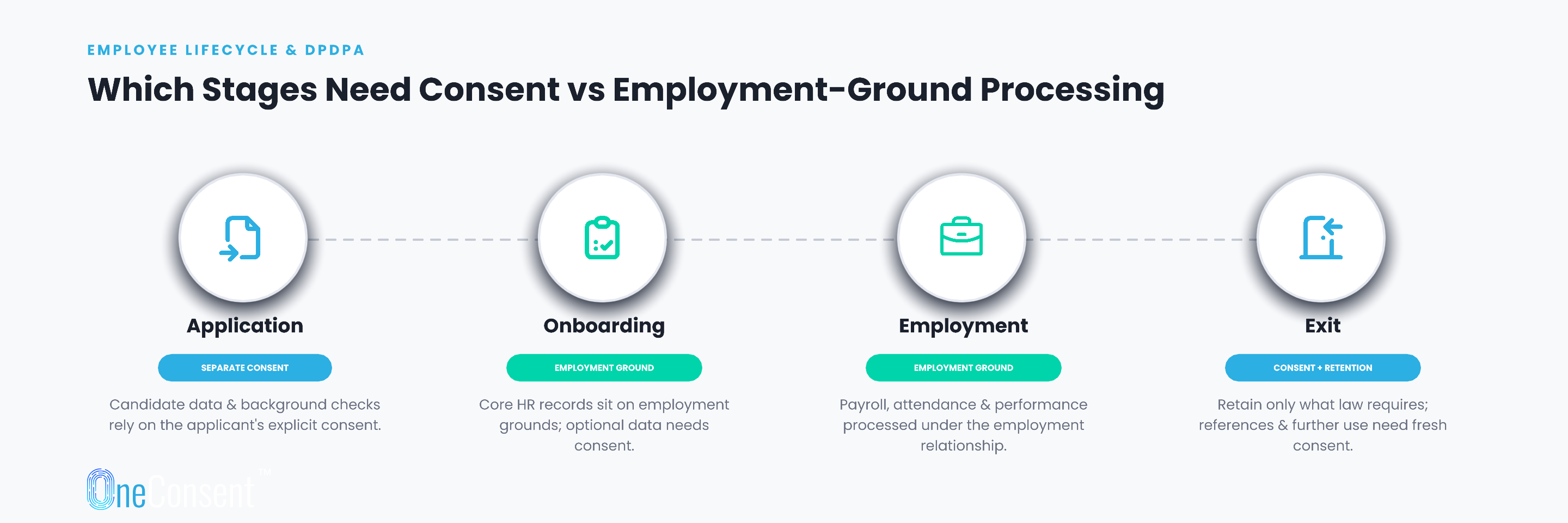
Here's where things get genuinely useful for HR teams trying to figure out what is actually needed in a fresh consent flow. DPDPA includes a legitimate use ground for processing "by an employer in relation to employees," which means not every piece of HR data processing requires Section 6 consent. Processing that's necessary for the employment relationship itself, think payroll runs, tax filings, statutory provident fund compliance, can rely on this ground without a separate consent capture.
But that ground has limits, and this is where a lot of organisations get sloppy. Data processing that goes beyond what's strictly necessary for employment, such as collecting health data for benefits planning, running background checks ahead of a promotion, or sharing employee data with group companies for HR analytics, needs separate consent or another clearly defined legal basis. The test isn't "is this employee data," it's "is this specific use of the data necessary for the employment relationship." Those are two very different questions, and HR policies that treat them as the same thing are the ones most likely to run into trouble.
This same logic shows up across other regulated sectors too. Like for example Healthcare sector, where personal data collected for one legitimate purpose is often reused for additional purposes, creating potential consent gaps under the DPDPA.
Biometric Attendance Is the Riskiest Data Point in the Building
Fingerprint or facial recognition systems used for attendance tracking are now common across Indian offices, factories, and retail outlets, and they involve some of the most sensitive personal data an organisation can hold. Processing this kind of data requires explicit consent, and employees need to be told clearly that they have a right to withdraw that consent, even though in practice this right may be limited where the employer has a genuine operational need for the attendance system to function. A biometric system installed years ago, before anyone was thinking about consent architecture, is exactly the kind of legacy gap that needs revisiting now rather than later.
Background Checks Need a Defined Scope, Not an Open Mandate
Background checks pull in data from third parties about a candidate or employee, which adds another layer of complexity. What can be checked, how long it's stored, and how long it's retained all need to be spelled out in your HR data policy rather than left to the discretion of whoever's running the check that week. Collecting more background information than the role genuinely requires isn't just bad practice, it's a compliance risk under DPDPA's data minimization principle.
Data Minimisation Means HR Can't Hold Files Indefinitely
This is probably the single biggest behavioural shift DPDPA demands from HR functions. The Act's data minimization principle says you collect only what's necessary for the stated purpose, and that principle doesn't expire when someone leaves the company. Plenty of organizations still keep detailed personal files on former employees for years, sometimes indefinitely, with no operational reason beyond habit. That practice needs an honest review against DPDPA's retention limitation obligations. If there's no statutory requirement or active legal reason to keep a former employee's health records or disciplinary history five years after they've left, holding onto that data is now a liability rather than a convenience.
Employees Have the Same DSAR Rights as Customers
This one catches HR teams off guard more often than it should. Employees can exercise the same DSAR rights as any customer: access to their data, correction of inaccuracies, and in certain cases, erasure. That means HR needs a working process for retrieving and producing data across every system it touches, payroll software, the HRMS, performance management tools, and biometric attendance logs, when an employee actually files a request. Building this process reactively, after the first request lands, is a much harder position to be in than having it ready in advance.
The same retrieval challenge shows up wherever organisations route personal data through customer-facing systems too. Same is applied on HR as well because scattered systems make DSAR fulfilment slow, and slow fulfilment is itself a compliance gap.
Where HR Teams Should Actually Start
A privacy notice update is not compliance. Real readiness means walking through every point in the employee lifecycle where data gets collected, from the job application to the exit interview, and mapping which of those points rely on the employment relationship ground and which need a separate consent mechanism. It also means writing an actual data retention policy with defined timelines, not an open-ended "we keep everything just in case" approach, and building the internal capability to respond to employee DSARs without scrambling.
Easyrewardz builds compliant employee engagement and data programs for enterprise organizations navigating exactly this kind of regulatory shift. Visit Easyrewardz to see how organization-wide data governance can be built around DPDPA from the ground up, with OneConsent consent management capabilities available for the specific consent workflows HR teams now need to operationalise.