Global CMP vs DPDPA-Native Software: A Practical Guide for Indian Enterprises
If your organisation is weighing whether to extend a global consent platform into India or move to something built specifically for DPDPA, this gives you the structural questions to ask instead of relying on a vendor's feature list or a generic cost comparison.
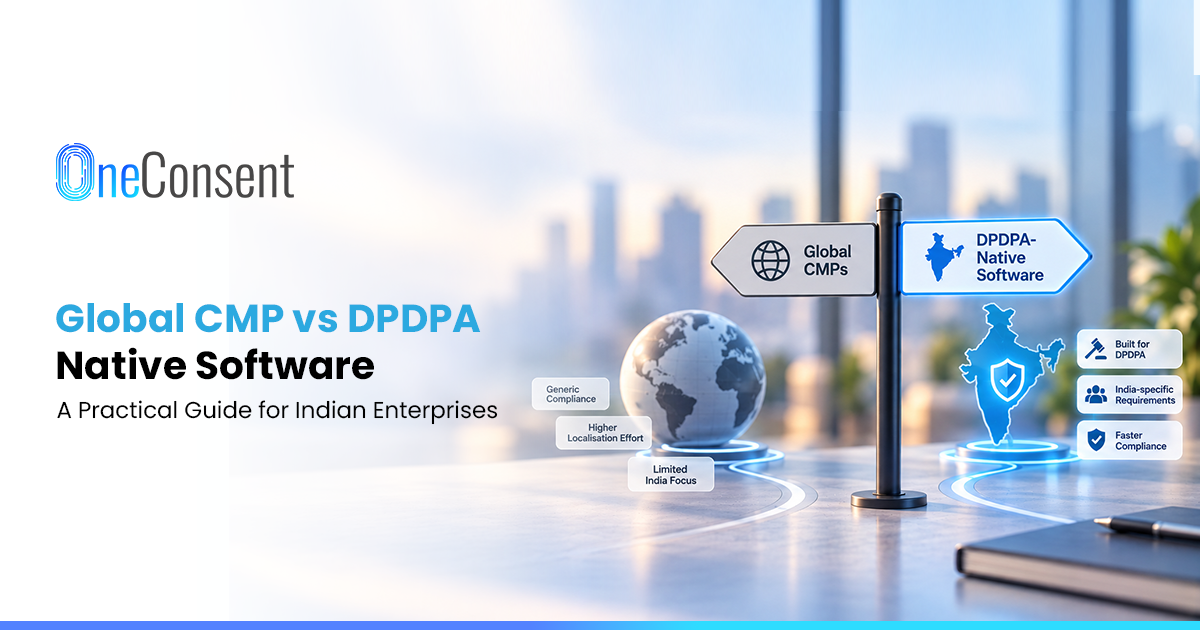
Search for platform alternatives to a well-known global consent management vendor and India-focused comparison content comes up within the first page of results. Several vendors now publish this exact comparison, and the case they make is fairly consistent: a global platform costs more, takes longer to deploy for an Indian entity, and its support desk runs on a different time zone. Those are real considerations. They are also not the strongest argument available, and treating them as the whole case understates what changes when a platform has to satisfy DPDPA specifically.
The stronger case rests on three DPDPA-specific requirements and implementation considerations that can materially affect how a CMP is designed and deployed in India. This article sets out what those three considerations are, where global platforms hold up well on their own, and how to evaluate the decision on structural grounds, not price alone.
Three DPDPA-Specific Considerations for CMP Architecture
Most privacy regulations share a common shape: consent standards, notice obligations, breach reporting, and individual rights. DPDPA follows that shape too, but three of its specific mechanisms were built around India's own regulatory architecture, not adapted from a template.
The Consent Manager model. Rule 4 of the DPDP Rules establishes Consent Managers as registered, interoperable platforms through which a Data Principal can give, manage, review, and withdraw consent across multiple Data Fiduciaries from one place. This is not a GDPR or CCPA concept. Legal and industry commentary commonly draws a comparison to India's own Account Aggregator framework, regulated by the Reserve Bank of India for financial data sharing. The DPDP Rules themselves don't formally establish that framework as the Consent Manager model's legal basis; the comparison is a widely used reference point, not a stated design origin. A platform built for European or American privacy law had no native reason to have ever built this kind of interoperability layer, because nothing in those frameworks required it.
The Eighth Schedule language requirement. Section 5(3) of the Act requires the Data Fiduciary to give the Data Principal the option to access the notice in English or any language specified in the Eighth Schedule to the Constitution. Section 6(3) places a parallel requirement on the consent request itself, in clear and plain language, with the same language-access option. Rule 3 then specifies the structure and content the notice must contain, an itemised description of the data, the specified purposes, and the mechanisms for exercising rights and withdrawal. A platform whose notice templates were built for GDPR's European languages or CCPA's English-and-Spanish baseline was not designed around this requirement, and supporting it properly means more than a translation plugin, since each language version still has to meet Rule 3's itemised, plain-language standard.
The three-date phased commencement. DPDPA does not go live on a single date the way most privacy laws do. Administrative provisions and the Data Protection Board came into force on 13 November 2025. Consent Manager registration and the enforcement and penalty machinery activate on 13 November 2026. The substantive notice, consent, and security provisions, including Rule 3, come into force on 13 May 2027. A compliance programme built around a single go-live date may therefore require additional planning to account for this staggered structure.
Where Global CMPs Hold Up, and Where the Gap Appears
A fair account of this comparison has to acknowledge what global platforms do well, since overstating the gap does not serve a CIO trying to make a genuine evaluation.
Global consent and privacy management platforms generally cover the broad privacy management surface competently: data subject access request automation, vendor and third-party risk assessment, data mapping, and breach workflow orchestration. An enterprise that already runs one of these platforms for GDPR or CCPA compliance across other markets has a real efficiency argument for extending that investment to India instead of running a second system. Independent analysis of this exact question has described the situation accurately: for a global platform, India tends to be one jurisdiction among many in its regulatory library, so India-specific behaviour typically arrives through configuration work instead of existing by default.
That configuration work is where the actual gap appears, and it concentrates in three areas. First, channel coverage: DPDPA-relevant consent in India can span WhatsApp, SMS, point-of-sale interactions, websites, and apps, depending on the organisation's customer journeys and processing activities, and platforms built primarily around cookie and web-form consent were not architected with these channels as first-class inputs. Second, the Consent Manager interoperability layer described above, which has no equivalent module to configure toward, since the underlying concept does not exist elsewhere. Third, output formats for the Data Protection Board specifically, including breach-related records and audit evidence in the form India's regulator expects, built separately from a format designed for a different regulator's requirements.
What "DPDPA-Native" Means in Practice
Against that backdrop of genuine architectural differences, the term used to describe platforms built for them deserves its own scrutiny. "DPDPA-native" has become a common term in India's consent management market, but it is applied inconsistently. In some cases it describes concrete architectural decisions, such as native Consent Manager readiness or built-in Eighth Schedule language support, the kind of design choices set out above. In others, it functions more as a general positioning label, with less detail available on the underlying design. Given that range, it is worth defining the term precisely before using it as an evaluation criterion, whether the platform under review is one of the established enterprise CMP software vendors in India or a newer, India-first entrant.
On that basis, a DPDPA-native platform should treat the three considerations above as first-class design constraints, not optional modules. That means Consent Manager interoperability built into the architecture instead of bolted on ahead of the November 2026 deadline, notice generation that produces a Rule 3-compliant notice in Eighth Schedule languages by design, and consent capture that treats WhatsApp, SMS, and point-of-sale channels as equal citizens alongside the website, instead of extensions added after the core product was built for cookie consent.
Our consent management platform buyer's guide for India covers the fuller evaluation criteria in more depth.
A Practical Framework for Evaluating This Decision
A structural comparison works better than a generic feature checklist, since it tests how a platform is built, separate from what it claims to support. These are the questions worth asking directly, whichever platform your team is evaluating.
Consent Manager interoperability. Ask whether it is a built-in capability, or a stated roadmap item ahead of the November 2026 deadline.
Live Eighth Schedule notice. Ask to see one directly, an actual Rule 3-structured notice rendered in a scheduled language other than English, not a translated version of a marketing page.
Native channel support. Ask which channels are natively supported for consent capture, and confirm WhatsApp, SMS, and point-of-sale stand alongside web and app, instead of requiring a separate integration project.
Regulatory reporting and audit evidence. Ask how the platform supports breach-related records, regulatory reporting, and audit evidence, and request a sample output, not a description of the capability alone.
Roadmap against commencement dates. Map the vendor's roadmap against the three DPDPA commencement dates, and confirm delivery timelines for Consent Manager support and Rule 3 notice tooling land ahead of 13 November 2026 and 13 May 2027, not after.
A Quick Self-Check for Your Current Platform
Language readiness. If a Data Principal asked for their notice in a Scheduled language other than English or Hindi, could your current platform produce one today?
Consent Manager plan. Does your platform have a defined plan for Consent Manager interoperability ahead of the 13 November 2026 deadline?
Channel parity. Can your platform capture and evidence consent on WhatsApp and at point of sale with the same rigour it applies to your website?
Regulatory format. If the Data Protection Board requested breach-related records or an audit export, could your team produce them without manual rework?
Roadmap ownership. Is your current platform's India roadmap driven by DPDPA's three commencement dates, or by your vendor's global release calendar?
Why OneConsent Was Built DPDPA-Native, Not Adapted
OneConsent was designed around Section 6 consent standards, Rule 3 notice requirements, and Rule 4 Consent Manager interoperability as core design constraints from the outset, not added to an existing global architecture after the fact. Consent capture treats WhatsApp, SMS, point of sale, app, and web as equal channels by design, not as integrations layered on top of a cookie-consent core.
The platform generates Rule 3-compliant notices in Eighth Schedule languages, and its consent evidence and audit trail capabilities are structured to match Data Protection Board reporting expectations, built for this regulator specifically, not adapted from a template designed for a different one. Testing that distinction directly, whether a platform was built for this regulatory structure or configured toward it after the fact, is exactly what the framework above is for.
A Practical Next Step
If your organisation is currently running a global platform extended into India through configuration, a useful starting point is running the five evaluation questions above against your current setup and identifying which answers point to genuine gaps, not planned future capability. The same five questions apply however that comparison is framed, whether the alternative under review is one of the more established consent management platform providers in India or one that comes up often in best-CMP comparisons.
Book a demo to see how a DPDPA-native platform handles Consent Manager interoperability, Eighth Schedule notices, and channel coverage.
Visit OneConsent to explore the platform in more detail.
Frequently Asked Questions
Have more questions?
Search our full DPDP knowledge base for more answers.