How to Choose DPDP Compliance Software: Buyer Checklist
Every DPDP compliance tool looks complete in a demo. The checklist that matters is the one that tests what happens after a customer changes their mind.
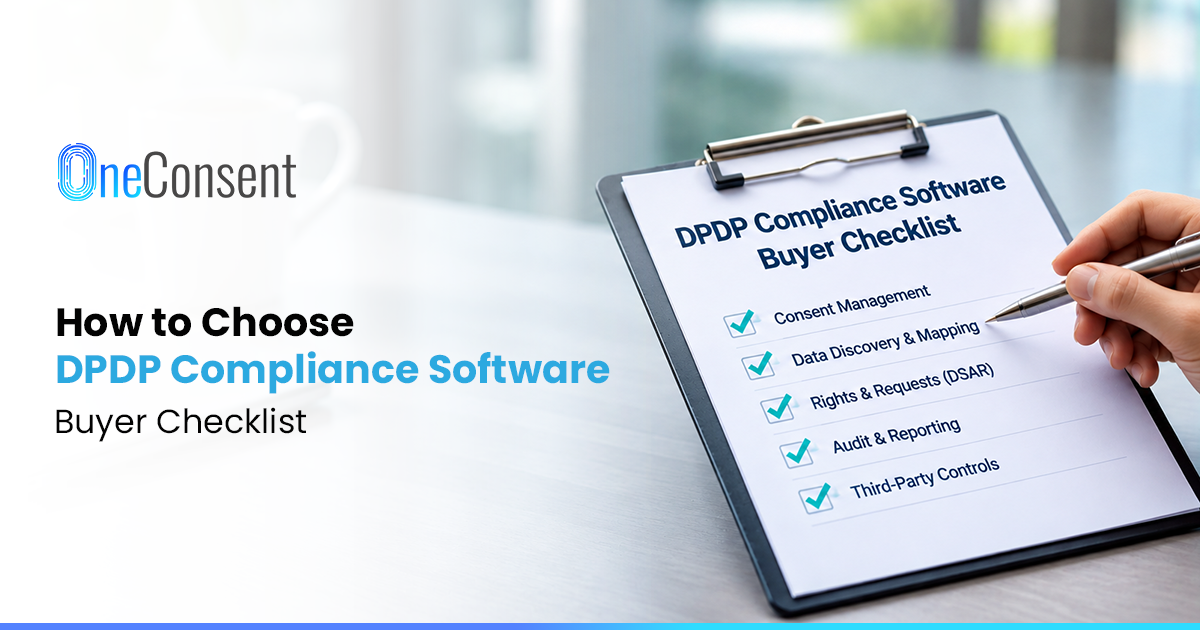
Most vendor demos look alike. A consent banner, a dashboard and a list of features, each mapped to a section of the Digital Personal Data Protection Act, 2023. The differences show up later, when a customer withdraws consent at a store and the question is whether that choice reaches the SMS vendor by evening.
This checklist is meant for teams evaluating DPDP compliance software. Each item cites the Act or the DPDP Rules 2025 where the requirement comes from the law, and the remaining items are good practice. That distinction matters, because the law sets outcomes and does not prescribe any particular tool. Rule 4 applies from 13 November 2026, and Rules 3 and 5 to 16 apply from 13 May 2027.
1. Consent Capture and Notices
Purpose-level consent. Under Section 6(1), consent must be free, specific, informed, unconditional and unambiguous, and limited to the specified purpose. Check that the software records consent separately for each purpose, not as a single yes or no.
Every touchpoint. Ask whether consent can be captured at POS terminals, call centres, WhatsApp and paper forms, as well as on websites and apps.
Rule 3 notices. The notice must be understandable on its own, give an itemised description of the personal data and the purpose, and explain how to withdraw consent, exercise rights and complain to the Data Protection Board.
Languages. Section 5(3) gives customers the option to read the notice in English or any language in the Eighth Schedule to the Constitution. Confirm which languages the software supports out of the box.
Legacy data. For consent taken before the Act came into force, Section 5(2) requires a notice as soon as reasonably practicable. Ask how the software handles that one-time notice.
Children's data. If minors may use the service, check support for verifiable consent from a parent or lawful guardian under Section 9 and Rule 10.
Related Reads: How to Build a DPDPA-Compliant Consent Notice: Language, Clarity and Opt-In Design A practical guide to writing notices that meet Rule 3 and are easy for customers to understand.
2. Withdrawal That Reaches Every System
The ease of withdrawing consent must be comparable to the ease of giving it. Once consent is withdrawn, the Data Fiduciary must stop processing within a reasonable time and ensure its processors stop as well.
In a buying process, tools can differ most on this point. Ask for a live demonstration: withdraw consent in one channel and show it reflected in the CRM, marketing tools and third-party vendors. Check for APIs or webhooks that push the change automatically, since a nightly file export leaves a gap.
Related Reads: The Complete Lifecycle of Consent: From Capture to Withdrawal.
3. Records That Hold Up as Evidence
Section 6(10) places the burden of proving that a notice was given and consent obtained on the Data Fiduciary. The software should link each consent to the notice version, timestamp, channel and purpose. Records should be protected from alteration and easy to export.
Separately, Rule 6 requires certain logs and personal data to be retained for one year to detect and investigate unauthorised access. Ask whether the software's logging supports that requirement.
4. Rights Requests and Grievances
Sections 11 to 14 give Data Principals the right to access information, seek correction and erasure, raise grievances and nominate another person. Rule 14 requires the business to publish the period for responding to grievances, which must be reasonable and not exceed 90 days.
Look for a request portal, identity verification, assignment to owners and tracking against deadlines.
5. Retention and Erasure
Personal data must be erased when consent is withdrawn or the purpose is no longer served, unless another law requires it to be kept. For e-commerce entities and social media intermediaries with at least two crore registered users in India, and online gaming intermediaries with at least fifty lakh, the Rules set a three-year period from the user's last contact for specified purposes, and a notice to the user at least 48 hours before erasure.
Check whether retention periods can be set per purpose and whether the software flags data that is due for erasure.
6. Security, Breach Support and Hosting
The Act requires reasonable security safeguards. In a breach, Rule 7 requires affected Data Principals and the Board to be informed without delay, with further details to the Board within 72 hours of becoming aware of it, or within a longer period the Board allows. (Legal requirement) Software that can quickly identify affected individuals and their contact details makes this easier.
On hosting, the Act allows transfers outside India except to countries the government restricts. Sectoral rules, such as the RBI's payment data storage directive, may still require data to stay in India. Ask where data is hosted and whether that location can be chosen. (Depends on sector)
7. Integration, Scale and Exit
These points are commercial and not legal, and they often decide whether a DPDP compliance software rollout succeeds:
Confirm that it integrates with the CRM, loyalty, messaging and data tools already in use.
Confirm that one setup can support multiple brands or business units.
Confirm what implementation involves and who on the vendor side owns it.
Confirm how pricing is structured as customer volumes grow.
Confirm that all consent records can be exported in a usable format if the contract ends.
A registered Consent Manager under the Act is different from software a brand uses for its own customers. Any consent management platform in India should be clear about which role it plays.
Software, Consultation or Both
A search for DPDP compliance companies in India returns law firms, advisory practices and software vendors. A DPDP compliance consultation helps interpret obligations, set governance and decide what the business needs. A DPDP compliance platform runs those processes every day. An enterprise can use both, and the checklist above works best when legal and technology teams review it together.
Mapping Your Requirements Before Vendor Shortlisting
Before shortlisting any vendor, a business needs a clear picture of whose data it holds, for what purposes, through which touchpoints and in which systems. OneConsent supports this through a structured discovery flow that maps industries, data principals, purposes, touchpoints, data fields, business applications and storage, and sets default consent, retention period and consent validity for each purpose. The output is a consent matrix with a system and storage inventory, which gives buyers a concrete set of requirements to test vendors against. To see how the OneConsent consent management platform supports DPDPA compliance, book a product demo.

Meenali Chourasia is a Product Manager with 10+ years of experience leading product strategy, roadmaps and growth across mobile apps, websites and SaaS platforms. She has built and scaled consumer and enterprise products at MTAP Technologies, Hungama Digital Media and Justdial, where she drove measurable impact on user engagement, retention and revenue through data-led decision making. Her expertise spans strategic roadmaps, product design, requirements gathering and KPI tracking using tools like Amplitude and Firebase. Meenali holds a PGDM in Marketing and International Business from New Delhi Institute of Management. At Easyrewardz, she focuses on shaping consent-first product experiences that help Indian enterprises navigate the DPDP era with confidence.
See all articles by meenaliFrequently Asked Questions
Have more questions?
Search our full DPDP knowledge base for more answers.