How to Implement a Consent Management System Under India’s DPDP Act?
A practical, end-to-end guide to implementing a consent management system under India’s DPDP Act. Learn what it takes to move from scattered consent records to a system that works across your business.
Implementing a Consent Management System (CMS) under India’s DPDP Act requires more than a checkbox. Businesses must understand the role of a Consent manager, avoid relying only on Cookie Consent management, and know what a Consent manager under the DPDP Act means before building compliant customer data workflows across websites, apps, POS, CRM, WhatsApp, and Loyalty Programs.
India's Digital Personal Data Protection Act (DPDPA), 2023, is the operating standard for how every business that touches customer data in India must function. If your organization collects information through billing counters, CRM forms, loyalty programs, WhatsApp campaigns, or a website contact form, you are classified as a Data Fiduciary under the law, and that classification comes with real obligations. Non-compliance carries serious financial consequences: the Data Protection Board of India is empowered to levy penalties of up to ₹250 crore per instance of data breach or non-compliance, depending on the nature and scale of the violation.
As enforcement timelines approach, DPDP compliance has shifted from a "nice to have" compliance project to a business-critical priority that touches legal, marketing, IT, and customer experience teams alike.
Most Indian businesses already collect consent in some form. The issue is that consent is often scattered. A customer might unsubscribe from email but continue receiving WhatsApp campaigns. A retail store might collect a phone number for billing, while a marketing tool later uses the same number for promotions.
A central consent management layer tracks consent, connects it with a specific purpose, maintains proof, manages withdrawal, and synchronizes customer preferences across every connected system. This guide breaks down how to implement a consent management system under India's DPDP Act into 9 practical steps.
1. Map your complete customer data universe
Implementation starts by identifying where customer data enters, moves, is stored, and gets activated across the business.
For most companies, this goes beyond the website. Data could be gathered through mobile applications, billing counters, POS, CRM forms, loyalty sign-ups, WhatsApp chats, SMS, emails, customer support, event registrations, partnership marketing, and offline forms that are converted to digital afterwards.
A useful way to approach this is to map the data universe across five questions: what data is collected, through which touchpoint, in what format, which system or vendor processes it, and why the business uses it. This gives teams a practical data-flow view before the Consent management system is configured.
This exercise usually reveals some unexpected gaps – legacy lead forms, general opt-in, consent buried within terms and conditions, and systems gathering data from customers without a valid consent trail. The implementation works best when these data flows are visible before deployment.
2. Separate consent, legitimate use, and purpose-specific permissions
Not every data use needs the same consent treatment.
One broad checkbox should not cover every future customer interaction. Companies should separate transactional notifications, loyalty communications, promotional WhatsApp messages, emails, recommendation engines, surveys, profiling, and third-party data sharing from one another.
For instance, customers who share their mobile numbers in order to get delivery updates do not necessarily give permission to receive promotional WhatsApp messages. Likewise, participating in a loyalty program does not imply permission for profiling.
Purpose-based consent gives customers real control and gives business teams cleaner, better-permissioned data to work with. A strong system should let teams capture, update, and enforce each permission separately.
3. Create clear consent notices
Consent becomes relevant only when the customer knows what they are consenting to.
Before collecting personal information, an organization must give clear notice: what information is being collected, why, how it will be used, and how customers can revoke consent.
Businesses should give notice at the time personal information is collected. For instance, if a customer gives their phone number while billing, the customer needs to know that this number will be used either for billing, or for delivery notifications, or for offering them any benefits associated with being a loyal customer, or for sending them marketing messages.
This practice helps build a stronger consent record. Businesses should also configure a simple preference centre where customers can manage channel-wise and purpose-wise consent without depending only on support teams.
4. Deploy a central Consent management system (CMS)
Once data flows and consent purposes are mapped, the business needs a central Consent management system.
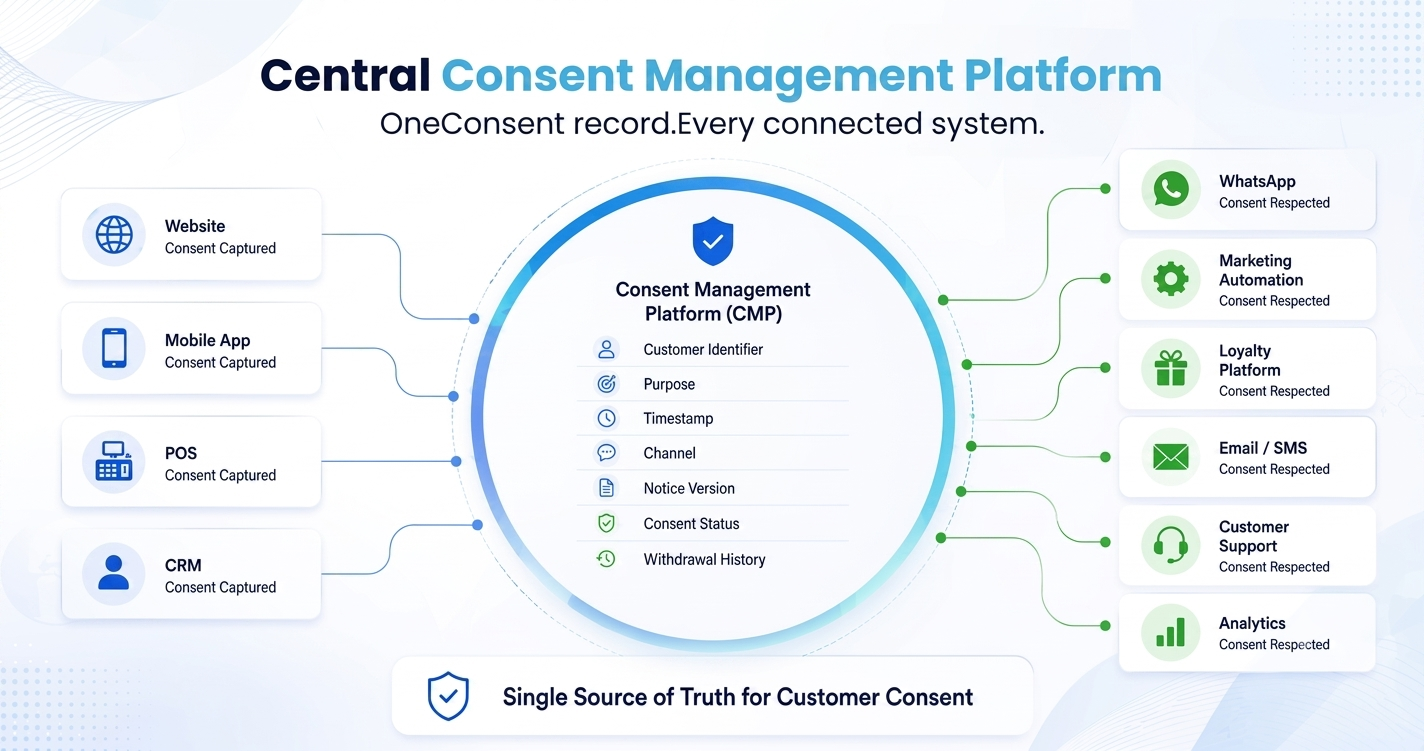
Such a system will need to capture who consented, at what time, to what purpose, under what notice, via which channel, and whether that consent was ever modified.
The system must become the single point of truth regarding customer consents. Organizations cannot rely on spreadsheets, one-time exports, or individual consents stored within applications. These approaches fall apart quickly once an organization has millions of customers spread across multiple stores, apps, websites, and marketing platforms.
The centralized consent layer will also help with proving consent. In case there is ever any doubt about the validity of consent, the organization will need to prove both the notice and the consent dates.
5. Integrate consent with business systems
A consent record is not enough if it does not control business action.
The Consent management system needs to be integrated with the CRM, CDP, POS, marketing automation, WhatsApp solutions, SMS, email, website, mobile app, analytics, and customer support systems.
Before launching a campaign, the platform must verify whether the customer has consented for that specific use case and channel. Any changes made by the customer on the preferences must flow across all systems. The consent will have to follow the customer.
6. Implement Cookie consent management, but do not confuse it with full DPDP readiness
Cookie consent management is necessary, but it isn't the same as full consent governance; it typically covers only website tracking tools like analytics cookies, ad pixels, retargeting tags, and third-party scripts.
Data collection for Indian enterprises goes far beyond cookies, spanning apps, stores, call centres, CRM, loyalty programs, WhatsApp chat flows, email tools, and physical engagement. A cookie banner cannot manage all of that.
That is why Cookie consent management should sit inside a wider Consent management system. The cookie layer handles website tracking preferences. The consent system governs customer permissions across the full data lifecycle.
From an implementation perspective, Cookie consent management should also support pre-consent blocking. Analytics cookies, advertising pixels, retargeting tags, and third-party scripts should not fire until the visitor has given the required consent.
7. Build withdrawal and Data Principal rights workflows
Withdrawal should be simple for customers, but the same workflow should also support access, correction, erasure, and grievance requests.
Organizations may facilitate such withdrawal through various means like a preference centre, mobile application, email link, WhatsApp conversation, subscription withdrawal facility, customer portal, or customer service ticket. The medium doesn’t matter much; what matters is that the withdrawal reflects across all systems. This is where many companies fail. A customer opts out, but an older campaign list continues to run. Or the CRM updates, but the WhatsApp platform does not. Or a support ticket is closed manually, but no system-level change happens.
A central platform should close these gaps by making withdrawal enforceable across all relevant systems.
8. Maintain audit-ready consent records
For DPDP readiness, businesses must be able to prove consent, not just claim that it exists.
A good consent record should include customer identifier, purpose, timestamp, channel, notice version, consent status, withdrawal history, and system source. For large companies, this is simply impossible to maintain using spreadsheets.
Audit-ready records help legal, compliance, marketing, and technology teams operate from a single version of the truth. They will also enable the company to react quickly when a customer makes a request.
9. Understand the Consent Manager under the DPDP Act
The phrase Consent Manager under the DPDP Act is often misunderstood.
A Consent manager under the DPDP Act is a registered entity that enables Data Principals to give, manage, review, and withdraw consent across participating Data Fiduciaries. A Consent management system is the internal business platform used to collect, store, update, enforce, and prove consent across company systems.
The distinction matters. A Consent manager supports the individual. The internal consent platform supports the business. Companies should understand both roles, but they still need their own consent infrastructure.
To know more about CMP under the DPDP Act, read You're Probably Already Breaking India's New Data Law - And You Don't Even Know It.
Common implementation mistakes
Many businesses implement consent too narrowly. The most common mistake is treating Cookie consent management as complete DPDP compliance. A cookie banner may help with website tracking, but it does not manage consent across POS, CRM, WhatsApp, loyalty programs, call centres, and marketing tools.
Other mistakes include using one broad checkbox for multiple purposes, storing consent only inside the CRM, managing withdrawals through spreadsheets, running campaigns from old exports, and collecting consent without versioned notices.
The safest approach is to treat consent as infrastructure across the customer data layer. That's exactly the role a dedicated Consent Management Platform (CMP) plays: doing what spreadsheets and scattered app settings simply cannot do at scale. It becomes the single source of truth for every consent event, regardless of which channel it came from.
How OneConsent by Easyrewardz simplifies implementation
OneConsent by Easyrewardz is DPDP compliance software built to help Indian businesses implement consent governance under the Act.
OneConsent embeds consent into the customer data layer instead of treating it as a separate compliance record. This helps businesses manage consent where customer data actually lives and moves.
OneConsent supports purpose-level consent capture, OTP-backed validation, audit-ready consent records, real-time API enforcement before outbound communication, withdrawal propagation across connected systems, right to be forgotten workflows, grievance redressal modules, and AI-powered compliance monitoring.
For businesses with legacy databases, OneConsent also helps address the transition from old customer records to DPDP-ready consent governance.
Final thoughts
Implementing a Consent management system under India’s DPDP Act is not just a compliance project. It is an operating model for responsible customer data use.
Businesses that act early will be better prepared to honour customer choices, reduce campaign risk, improve first-party data quality, and build trust as DPDP enforcement approaches.
Ready to move from fragmented consent records to a DPDPA-compliant, enforceable consent layer? Explore OneConsent or book a demo to see how it works.
Frequently Asked Questions
Have more questions?
Search our full DPDP knowledge base for more answers.