How to Minimise Drop-Off in Your Consent Journeys: UX Best Practices for Indian Businesses
A compliant consent journey that customers abandon is a compliance failure and a business failure. Here is how to build consent journeys that are genuinely informing and genuinely converting.
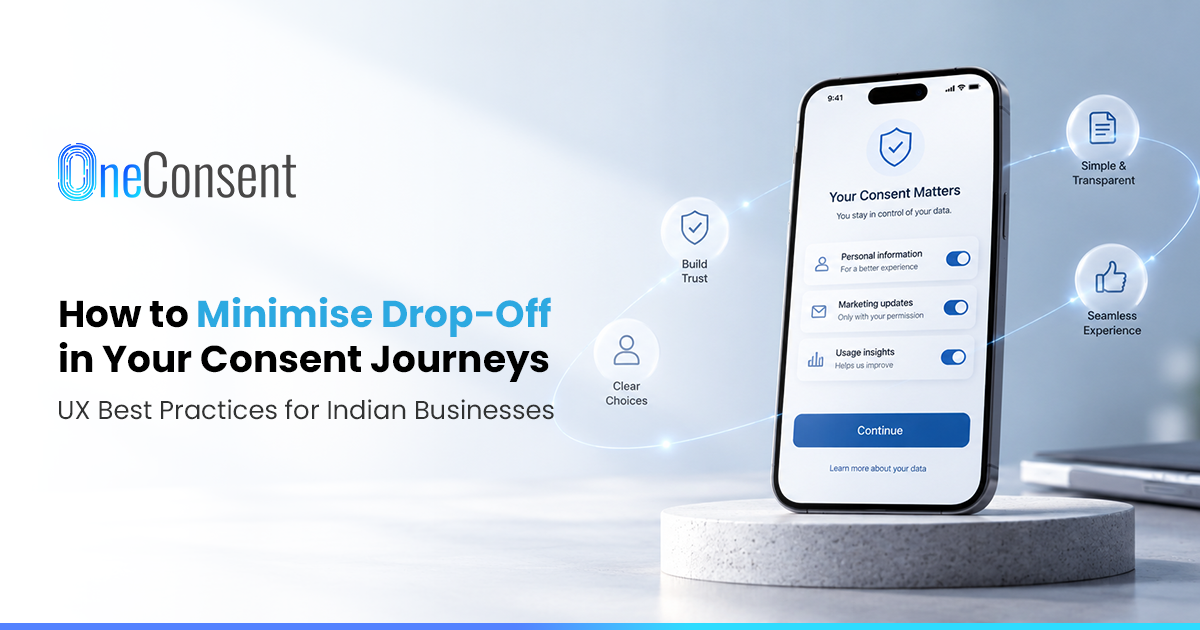
A consent journey can meet every technical requirement in the DPDPA and still lose customers along the way. The business has done its compliance duty, but the person on the other end still finds the experience clunky, confusing, or a little bit annoying.
Does Higher Consent Friction Mean Better Compliance?
A belief circulates in DPDPA compliance circles, and you have likely heard some version of it. Consent drop-off is the cost of doing things properly. Customers who do not consent did not want to, and that is their right, so the business moves on.
Look at the data carefully. That idea starts to fall apart. Often than not high drop-off rates aren't about what customers actually want. They're, about how the experience was built. A form that’s hard to follow. A block of text that no one even tries to read. A process that feels like a chore of a smooth path. None of this shows a refusal to share data. It shows friction.. Friction is almost always a design issue that you can fix.
Your actual goal is a consent journey that informs people properly and still converts well. Those two things get treated as opposites more often than they should be. The next few sections work through why.
Where These Journeys Usually Fall Apart
A handful of problems show up again and again in most consent flows, almost like a checklist of what not to do.
Walls of Text and Choice Overload
Long legal notices get scrolled past without a single line being read, regardless of how well they are written. Hand someone a dozen consent toggles at once, and the more likely outcome is the tab closing, not the toggles getting sorted through carefully.
Tone, Mobile Experience, and Timing
Tone matters more than people give it credit for. Overly legalistic language can make routine data processing sound more complex or concerning than it actually is. Layer a clunky mobile experience on top, a flow designed for desktop and squeezed onto a phone screen as an afterthought, and abandonment stops being a surprise.
Then there is timing. Asking for consent before someone understands what they get in return is a bit like a stranger asking for a favour before introducing themselves. There is also a familiar imbalance worth naming: accepting takes one tap, declining sends someone down a maze of sub-menus. Your customers notice that asymmetry even when they cannot explain exactly why it bothers them.
Timing turns out to matter enough that it deserves a closer look on its own.
Ask at the Right Moment
Asking for marketing consent right after a purchase is a different experience from asking during registration, before any trust has been built. After a transaction, some goodwill is sitting there. During onboarding, there is none yet, and asking too early spends trust you have not earned.
The same idea applies to location permissions. Asking the moment someone opens a location-based feature makes sense to them in the moment. Asking during onboarding, out of nowhere, feels invasive. Context separates a reasonable request from a random one, and once timing is right, the next question is how much to ask for at once.
Break It Into Stages
Handing a customer every decision in one sitting drives people away, and your consent flow should not ask for that.
Core service consent fits naturally at registration. Marketing consent lands better after a first positive interaction, once some goodwill has built up. Personalisation consent makes the most sense right at the point where the customer would notice the benefit, which is also where preference management earns its keep, since each stage records a distinct, purpose-specific choice rather than one blanket toggle.
This is stronger legal design too, since each request stays tied to a specific, understandable context instead of getting bundled into one overwhelming ask. Getting the structure right still leaves one more variable: how each individual request is worded.
Lead With the Value
Consent can be framed around what the customer gains instead of what data is being handed over. This reframing takes minutes to test and often moves conversion more than a full redesign would.
Same Request, Different Framing
Take two versions of essentially the same request. "Do you consent to use of your purchase data for analytics?" versus "Allow us to use your purchase history to recommend products you will love?" The underlying information is identical. The feeling is not. One reads like a legal checkbox. The other reads like an offer worth considering.
This is honest communication, framed around what the customer gets out of it instead of only what the business needs from them. None of it works if the surrounding language is hard to read.
How Plain Must Consent Language Be Under DPDPA Section 6(3)?
A simple test works for consent notices. I wonder if someone landing on your platform for the time can understand the consent notices in about thirty seconds, on their phone without squinting or re-reading the sentence twice. If the answer is no, the language or presentation of the consent notices needs simplifying.
Plain language reduces cognitive load and can help minimise abandonment during the flow. Under DPDPA, this is not optional. Section 6(3) of the Act says that every request for consent must be given in plain language. People must be able to access it in English or in any language that's part of the Eighth Schedule, to the Constitution. This is not something to aim for. This is the standard. It is the baseline. It must be followed. No exceptions.
For more on structuring the notice that sits in front of this journey, see How to Build a DPDPA-Compliant Consent Notice: Language, Clarity, and Opt-In Design
Wording and staging solve most of the problem, but a customer who drops out partway through still needs an answer for what happens next.
Never Make Someone Start Over
If a customer gets partway through a multi-step consent flow and agrees to some items before dropping off, the flow should save that progress instead of discarding it. Forcing someone to redo what they already agreed to is friction with no real purpose behind it.
Treating a flow as a failed attempt, instead of a legitimate, if incomplete expression of what the customer wants adds friction where none needs to exist. Respecting what the customer has already decided carries as much weight when the decision is no.
Make "No" Just as Easy as "Yes"
Making someone work harder to decline than to accept is one of the quickest ways to lose their trust.
A customer who says yes to service-related consent and no to marketing is still a customer. Arguably a better one, in the sense that they trust the business enough to be honest about where the line's
If your flow treats a decline as an end or quietly adds friction somewhere down the line as a consequence people notice and they remember. Treating a "no" with the respect as a "yes" tends to keep far more of the relationship intact.
The Real Cost of a Bad Consent Journey
Choosing, between DPDPA compliance and a decent customer experience turns out to be a choice. Get the timing right keep the language clear and treat both yes. No fairly and the numbers tend to follow: higher consent rates and records that hold up under scrutiny later. Compliance and good design were never pulling in directions. They just needed a design that treated people like people instead of line items.
Building a Consent Journey People Actually Finish
A good consent journey does not make you give up compliance for completion rates. OneConsent lets you collect consent in stages each for a purpose so core service consent, marketing consent and personalisation consent can each be requested at the right time instead of all together on one heavy screen. OneConsent saves your progress instead of throwing it away shows notices in plain language that follows Section 6(3) rules, in English and the other languages listed in the Eighth Schedule and keeps a record of every consent or decline in a traceable log that your compliance team can refer to later.
See how OneConsent structures staged consent flows that cut drop-off: oneconsent.ai
Walk through a live consent journey built around plain language and equal treatment for yes and no: book a walkthrough
Frequently Asked Questions
Have more questions?
Search our full DPDP knowledge base for more answers.