Multi-Tenant Consent Management: How Brands Can Run DPDPA Compliance at Scale
This article breaks down how multi-tenant consent architecture works, what it takes to keep consent records isolated and auditable across brands, and how OneConsent supports this structure at scale.
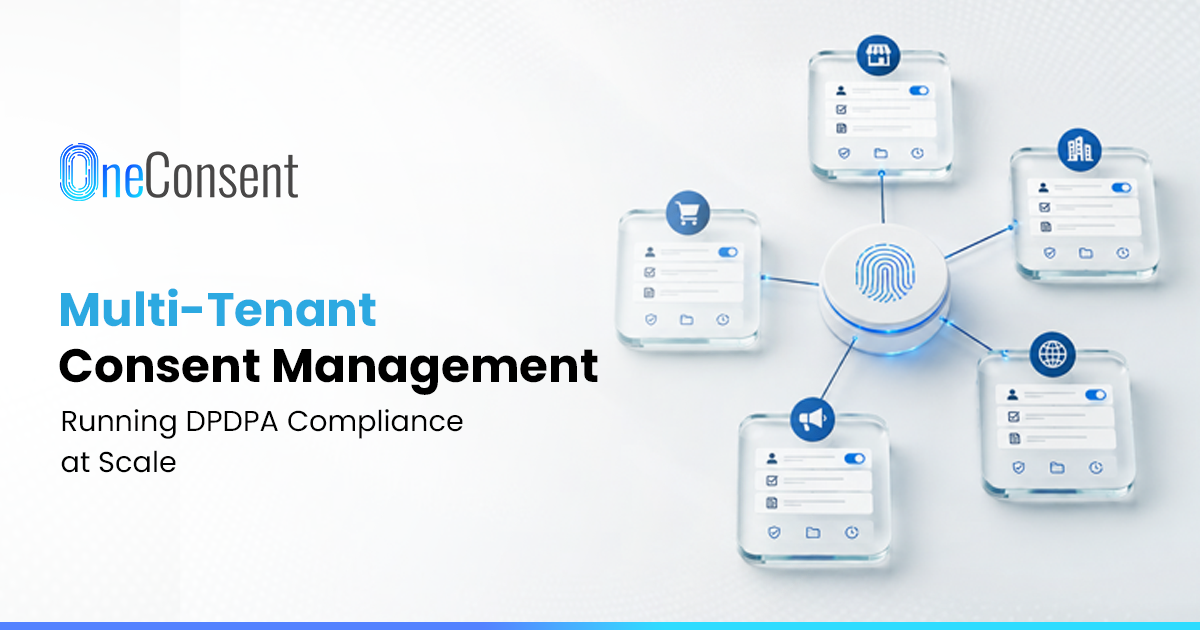
Picture three different businesses. A loyalty program operator running fifty retail brands on one platform. A CRM platform powering two hundred fintech clients. A white-label app provider whose own name never appears on the login screen, because every login carries a regional bank's logo instead. On paper, these companies look nothing alike. Underneath, they share the same requirement: DPDPA compliance that must work correctly for every tenant on their platform, not only for themselves.
That is the problem multi-tenant consent management is built to solve.
Every Tenant Brand Is Its Own Compliance Owner
Under the DPDPA, every brand client running on a shared platform is independently a Data Fiduciary, accountable for its own customers' data. A platform operator building the underlying infrastructure is building compliance for every tenant it hosts, whether that is fifty brands or two hundred.
Each tenant needs to collect consent under its own brand, its own notices, its own visual identity, and its own voice. Each tenant needs an audit trail specific to its own operations. Each tenant needs consent enforced at the processing level, independent of how any other tenant on the platform is configured. Each tenant needs to handle Data Subject Access Requests for its own customers, with clean separation from every other client's data. When reporting season arrives, each tenant needs evidence it can hand to a regulator that reflects its own operations only.
Missing any one of these creates a compliance gap that extends beyond the platform itself. It becomes legal exposure for another business, using its customers' data, under its own name.
Tenant Isolation Is a Core Architectural Requirement
Tenant isolation is the architectural rule that cannot be bent on a multi-tenant consent platform. Consent records, audit logs, and processing activity need to stay within their own tenant boundary in every scenario, including edge cases and unplanned failures. A single cross-tenant data exposure can create DPDPA exposure for the platform operator and for every affected client at the same time.
This is why tenant ID should never be accepted as a client-supplied request parameter or form field. It should be derived from a verified JWT (a signed authentication token) on every request, so tenant boundaries are enforced by the platform itself rather than by convention or client discipline.
Every Brand Tracks Its Own Notice History
Privacy notices need individual tracking across every tenant brand, even within the same platform. Each tenant brand has its own collection practices, its own processing purposes, and its own way of explaining things to customers. The platform needs to track notice version history separately for every tenant, with genuinely tenant-specific notice content for each brand rather than shared boilerplate.
Storing old versions needs to go further than simple archiving. When a brand updates its notice, every consent grant tied to that update needs a clear link back to the exact version the customer saw at the time. If a regulator or a customer asks what a customer agreed to and when, the platform needs to answer with precision, backed by a verifiable record. Under Section 6 of the DPDPA, consent must be specific, informed, and unambiguous, which requires knowing exactly which notice a customer saw at the moment consent was given.
Enforcing Consent at Real-Time Scale
Consider a platform with fifty tenant brands, each serving a million customers, with ten separate consent purposes tracked per customer. That works out to 500 million consent records, all of which need to be checked in real time, within sub-millisecond windows, every time the system processes someone's data.
This volume needs a purpose-built architecture. A Redis-based enforcement cache with tenant-scoped key name spacing, sitting on top of an append-only Postgres event store, is a common pattern for this kind of workload. The cache delivers speed. The event store preserves the permanent, tamper-evident record. Together, they let a platform enforce consent at scale, in real time, with a verifiable audit trail behind every decision.
Under Rule 4 of the DPDP Rules 2025, an entity registered as a Consent Manager must retain records of consent, notices, and data-sharing activity for at least seven years. A multi-tenant platform operating as a Data Fiduciary is a different category of entity from a registered Consent Manager, and the two obligations should not be conflated. Even without that specific mandate applying directly, building the storage architecture around a similar seven-year retention discipline is sound practice. It turns the underlying data architecture into both a performance requirement and a compliance asset.
Compliance Reporting That Respects Tenant Boundaries
Compliance reporting introduces a different isolation challenge. Each tenant needs its own numbers, consent trends, withdrawal rates, DSAR volumes, and audit trail, since each tenant carries its own regulatory accountability. Generating that report needs to happen without exposing what is happening on another tenant's account.
The fix is role-based access control done properly: tenant_admin roles that are hard-scoped to their own tenant's data, with no accidental visibility into anyone else's numbers. It sounds straightforward described that way. Getting it right across a platform serving hundreds of clients is a more demanding engineering problem than the description suggests.
Multi-Tenant Consent Management as a Business Advantage
This is exactly the kind of engineering that determines whether a platform can win the trust of brand clients evaluating how their customers' data will be handled by a third party.
Multi-tenant consent management is difficult to build well. It demands isolation that never fails, versioning that is precise down to the individual consent grant, enforcement that runs at real-time speed across hundreds of millions of records, and reporting that respects tenant boundaries even when everything runs on shared infrastructure underneath.
Get it right, and DPDPA compliance becomes a market-ready strength for platform operators, a capability they can present directly to prospective tenant clients as part of their value proposition. That is the difference between compliance as an obligation and compliance as infrastructure.
For platforms managing consent across multiple brands, tenants, and processing environments, a scalable consent management solution needs to combine strong tenant isolation with centralised governance and auditable consent records. OneConsent helps organisations build a DPDPA-focused consent layer that supports multiple business entities while keeping consent, preferences, and compliance records securely separated for each one.
If your platform manages DPDPA compliance across multiple tenant brands, schedule a demo with OneConsent to see how tenant isolation, notice versioning, and real-time consent enforcement work at scale.
Frequently Asked Questions
Have more questions?
Search our full DPDP knowledge base for more answers.