Omnichannel Consent Management: Capturing Consent Across POS, WhatsApp, Web & App
Learn how omnichannel consent management helps organisations unify consent across POS, WhatsApp, web, and app while maintaining consistent records, withdrawals, and audit trails for DPDPA compliance.
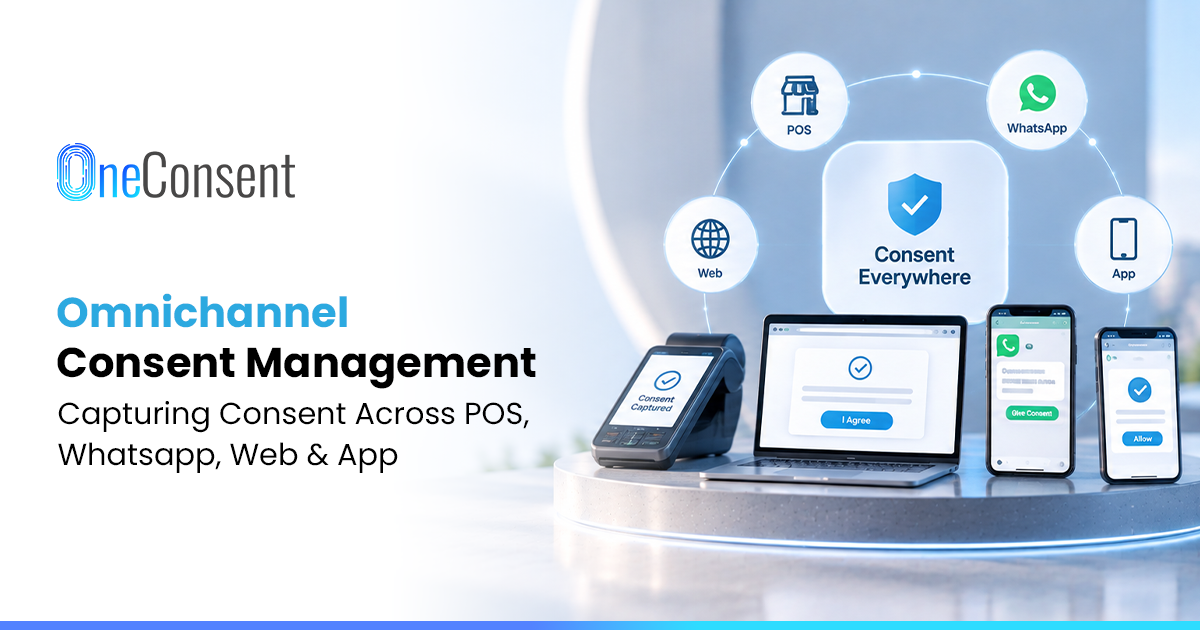
A customer buys at a store billing counter and signs a paper consent form, downloads the brand's app and taps through a permission screen, opts into WhatsApp updates through a click-to-chat advertisement, and later fills a newsletter form on the website. Four consent events, four systems, and by the time the compliance team is asked what this customer has agreed to, nobody in the organisation can answer with confidence.
This is the practical shape of omnichannel consent management under DPDPA. The term gets used loosely in MarTech circles to mean syncing marketing preferences across channels. Under the Digital Personal Data Protection Act, 2023, it means something more specific: one consistent, evidence-backed consent record for a Data Principal, regardless of which channel collected it.
This article sets out why consent fragments across POS, WhatsApp, web, and app in the first place, what DPDPA requires once that data comes into scope, and the practical steps to bring these channels under one framework.
Why Omnichannel Consent Is a Compliance Question, and a Marketing One
DPDPA does not set separate consent rules for a website compared to a WhatsApp message or a billing counter form. Section 6 applies the same standard everywhere: consent must be free, specific, informed, unconditional, and unambiguous, given through a clear affirmative action, regardless of the channel it was collected on.
What differs by channel is not the legal standard but the collection point, and Section 3 of the Act extends that standard further than many teams expect. The Act applies to digital personal data, and Section 3(a) explicitly includes personal data collected in non-digital form and digitised afterwards. A paper form filled at a store counter stays outside DPDPA while it remains on paper. The moment it is entered into a POS system or scanned into a CRM, it becomes digital personal data, and the full weight of Section 6 and Section 5 applies to it from that point.
This is why omnichannel consent management is fundamentally a consent architecture question, and only secondarily a marketing preference question.
How Consent Is Typically Captured Across Each Channel Today
Each of these four channels tends to collect consent through a different mechanism, often owned by a different team.
Point of sale. A billing counter form, a verbal confirmation logged by staff, or a POS terminal checkbox, usually captured by store operations instead of a compliance-owned system.
WhatsApp. An opt-in satisfying Meta's Business Messaging Policy, collected through a website checkbox, an SMS reply, or a click-to-WhatsApp advertisement, owned by the marketing or growth team.
Web. Cookie banners for tracking technologies and account or newsletter forms for other purposes, usually owned by the web and product teams.
App. In-app permission screens at onboarding and preference settings buried in the account menu, owned by the product or app engineering team.
Each of these mechanisms can be individually reasonable. The friction appears once an organisation needs to answer a single question about a single customer across all four.
Where Channel-by-Channel Consent Breaks Down
Four separate consent systems create four distinct compliance gaps, each of which surfaces at the worst possible time.
Fragmented records. The organisation has no single view of what a customer has agreed to, since POS, WhatsApp, web, and app consent typically live in four unconnected systems.
Withdrawal desync. A customer who opts out on the app can still receive WhatsApp promotions or a callback from the billing counter, because Section 6(4)'s requirement that withdrawal be honoured everywhere the data is processed has no technical path to reach every system.
Inconsistent notice. The purpose stated on a POS form rarely matches the wording shown in the app or on the website, which weakens the specific-purpose standard Section 6 sets, since the Data Principal effectively received four different explanations of the same processing.
Audit difficulty. When a Section 13 grievance names a specific channel, the compliance team has to search four systems to reconstruct one customer's consent history, instead of pulling one record.
What Omnichannel Consent Management Requires
Solving this is a matter of consolidation, not adding a fifth system alongside the existing four.
One Data Principal identity across channels. Every consent event, regardless of channel, needs to resolve to the same underlying customer reference, so POS, WhatsApp, web, and app records can be matched to one person.
Purpose-specific consent per channel, feeding one record. Consent captured at each touchpoint should still name its specific purpose, but flow into a shared record instead of staying siloed in the collecting system.
Real-time withdrawal propagation. A withdrawal on any channel needs to reach every connected system without a manual step, so Section 6(4)'s parity requirement holds in practice and in policy.
Consistent notice content. The substance of the Section 5 notice, including purpose, data categories, and grievance information, should stay consistent across channels even where the presentation differs between a POS receipt, an app screen, and a website form.
One consolidated audit trail. The organisation should be able to produce a single consent history for a Data Principal, with the purpose, notice version, and timestamp behind each event, regardless of which channel generated it.
Our guide on the consent lifecycle under DPDPA, from grant to management to revocation on one platform covers this in more depth.
Practical Steps to Bring POS, WhatsApp, Web, and App Under One Framework
Map every collection point. List every place the organisation currently captures consent, including store counters, WhatsApp opt-ins, website forms, cookie banners, and app permission screens.
Standardise the purpose language. Align the purpose wording used at each collection point, so a customer sees the same explanation of what they are agreeing to, whichever channel they are on.
Connect each channel to one consent record. Route consent events from POS, WhatsApp, web, and app into a shared record tied to the Data Principal, instead of leaving each system to keep its own log.
Wire withdrawal to every connected system. Confirm that a withdrawal on any one channel updates the CRM, marketing automation platform, and any other system processing that customer's data.
Digitise POS consent deliberately. Since a physical form only enters DPDPA's scope once digitised, build the digitisation step to capture the same fields the record needs, instead of transcribing a paper form later without that structure.
Test the audit path. Pick a sample customer and confirm the organisation can produce a full consent history, across all four channels, in one lookup.
A Quick Self-Check for the Current Setup
It is worth checking your current channel setup against these five points before assuming it is already working as one system.
Confirm single-view access. Establish whether one customer's complete consent history across POS, WhatsApp, web, and app can be produced from a single system.
Confirm withdrawal reaches every channel. Check that a withdrawal on the app reaches your CRM and your WhatsApp messaging platform without manual work.
Confirm purpose consistency. Verify that the purpose stated at your billing counter matches the purpose stated in your app and on your website.
Confirm digitised POS data carries full fields. Check that a paper form entered into the POS or CRM system carries the same consent fields the other channels capture.
Confirm audit speed. Establish how many systems your team would need to check if the Data Protection Board asked about a specific customer's consent.
Where OneConsent Fits
OneConsent captures purpose-based consent across POS, WhatsApp, web, app, and other channels, and resolves each event to a single Data Principal record, so the fragmentation described above does not carry through to your compliance posture.
The consent sync hub propagates withdrawal and preference changes across every connected system in real time, and consent evidence and audit trail capabilities keep the purpose, notice version, and timestamp behind every event, across every channel, ready to produce as one record.
A Practical Next Step
If your organisation currently manages POS, WhatsApp, web, and app consent as four separate systems, a useful starting point is mapping those collection points against the five requirements set out above and identifying where the biggest gaps show up.
Book a demo to review how a single consent record would work across your current channels.
Visit OneConsent to explore the platform in more detail.
Frequently Asked Questions
Have more questions?
Search our full DPDP knowledge base for more answers.