Virtual DPO vs In-House Privacy Team: How to Choose Your DPDP Operating Model
Virtual DPO vs in-house privacy team under DPDP: compare the legal baseline, three operating models and the factors that decide the right one for your business.
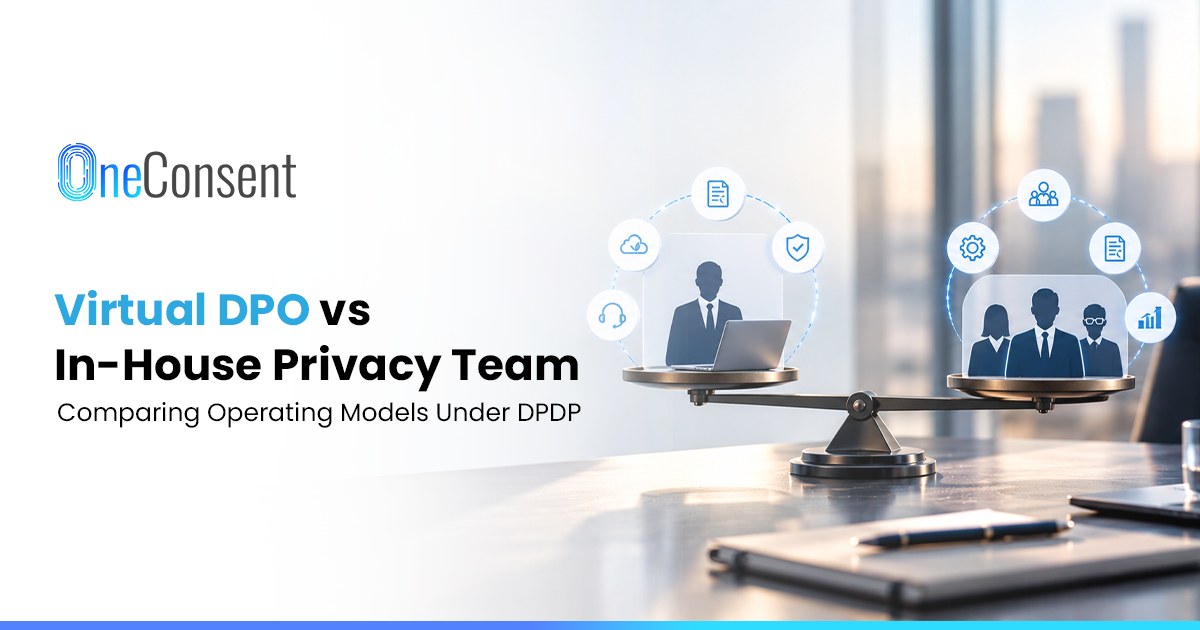
The core obligations of the Digital Personal Data Protection Act, 2023 (DPDP Act) take effect on 13 May 2027, and your leadership team has to settle by then who will manage privacy. That person or group answers customer concerns, keeps the business's privacy commitments current and sees that required changes reach the systems where customer data lives. You have three ways to staff the job: a Data Protection Officer (DPO) on the payroll, an outside adviser on retainer or a mix of the two.
A Data Protection Officer is compulsory only for a Significant Data Fiduciary notified by the Central Government. Other businesses can use an in-house team, a virtual DPO or a hybrid model, provided they publish a privacy contact and run a grievance process from 13 May 2027. A notified business should plan around a named internal individual.
A virtual DPO vs in-house privacy team decision affects the annual budget and the speed at which a privacy issue gets resolved. Only a Significant Data Fiduciary must have a DPO. The Central Government gives a business that status by notification, after weighing factors that include the volume and sensitivity of its personal data. Other businesses organise privacy work as they choose, though they still meet the duties that apply to all Data Fiduciaries. The existing guide on appointing a DPO covers the legal duty in detail:
Related Reading: Appointing a Data Protection Officer Under DPDPA: Who, When and How
Who Needs a DPO Under the DPDP Act, and What Stays Your Choice?
Significant Data Fiduciary status
A business becomes a Significant Data Fiduciary (SDF) only by notification, and the Central Government can notify a single business or a whole class of businesses. Size alone does not trigger it. The Government looks at factors that include the volume and sensitivity of the data and the risk to the people it belongs to (called Data Principals).
A notified business that breaches the additional SDF duties faces a penalty of up to ₹150 crore. Other duties, such as security safeguards, carry ceilings of up to ₹250 crore.
An SDF appoints a DPO who is a named individual based in India and answerable to the board of directors or a similar governing body. The DPO represents the business under the Act and acts as the point of contact for grievance redressal. The Act asks for an individual and says nothing about full-time status or employment, so an SDF should take legal advice before treating an external service provider as its DPO.
Two further SDF duties affect the choice of model. The business appoints an independent data auditor, and it carries out periodic impact assessments and audits. Independence is the point of the auditor role. The firm advising you as virtual DPO should therefore not audit the same programme, and the budget needs room for both.
Duties that apply to every Data Fiduciary
Any business that decides why and how it uses personal data is a Data Fiduciary. Many duties reach it on 13 May 2027, notified or not, and three bear directly on this decision:
Customers must be able to find the contact details of a DPO, where one exists, or of another person who can answer questions about their data. The Rules ask for that contact on the website or app and in every reply to a rights request.
A clear complaint route must appear on the website or app. Customers have to use it before they can approach the Data Protection Board, so the business sees each complaint first.
The Rules allow up to 90 days to respond to a grievance. Naming one owner for the complaints inbox makes that deadline easier to track.
A business that expects notification can appoint a DPO ahead of time. The board can use the interval to decide who would hold the role and which director or committee would receive the reports.
In-House Privacy Team: When Internal Ownership Matters
Product changes, customer campaigns, vendor onboarding and technology decisions all touch personal data. An internal privacy function earns its place when that happens often. Colleagues in such a team know which vendor holds the SMS list and which team edits the sign-up form. A proposed change therefore reaches the privacy lead before anyone approves it.
The lead works through issues with those teams and reports significant risks to the board. Customer data usually spreads across a CRM, a support platform and marketing tools. The lead knows who can retrieve the records, investigate a request and confirm that it was closed.
Building that function costs time and money. The role needs legal understanding, technical awareness and practical judgement in one person. Recruitment is therefore slow, and the business has to plan training and cover for the day a key employee leaves. Complex assessments and independent reviews may still call for outside specialists.
What a Virtual DPO Covers and What to Agree Before You Sign
A virtual DPO is an outside professional or firm paid on retainer to do DPO-type work. The DPDP Act does not use the term, so the contract defines the service. Typical scope covers advice on notices and consent and support for impact assessments and breach preparation. Some engagements add vendor reviews and staff training, and the retainer can grow before a product launch and shrink afterwards.
An adviser can assess only what the adviser can see, which makes the contract the main source of value. Before signing, agree these points in writing:
The named person who will act for you
Response times for incidents and rights requests
The systems and meetings the adviser can join
How concerns reach the board
Confidentiality terms
Any other services the firm sells you that could create a conflict
Handover arrangements for the day the contract ends
Even with full access, an adviser recommends a control while someone inside the business assigns the work, verifies completion and escalates any risk left open. A named internal owner therefore makes the retainer work.
On outsourcing, the Act describes an individual answerable to the board and does not say whether an external provider can hold that role. An SDF should confirm the point with counsel in writing. Because the Act is silent, a named internal individual supported by an outside adviser is the lower risk design.
Responsibility stays with the Data Fiduciary even when others do the work. GDPR Article 37(6) allows an external DPO. The DPDP Act has no matching provision, so the GDPR position cannot be assumed to apply in India.
Which Privacy Operating Model Suits Your Business?
A hybrid model gives one named person inside the business ownership of privacy and brings in an outside adviser for specialist work. Customers see the internal owner as the published contact, while the adviser covers impact assessments and vendor reviews.
Regulatory status, workload and capability
For a notified SDF, or one expecting notification, the starting point is a named internal individual with an adviser in support, since the Act builds the DPO role around one person answerable to the board. A business outside that group has no DPO requirement, full-time or otherwise, and can pick its model on practical grounds.
A business with many systems, vendors and launches needs someone inside who reviews changes as they arrive. Capability carries equal weight. If you already have a capable coordinator, a virtual DPO can carry the specialist work. If you do not, begin with a hybrid model and name the owner first, because advice with no internal owner may never become an operational change. Where a sector regulator already requires a named officer in your business, map that role against the DPDP roles before assigning new ones.
Cost and escalation
Cost reaches past a salary-versus-fee comparison. An internal team brings salary, training and retention costs. An adviser changes the staffing commitment, yet the business still needs internal capacity to carry out the recommendations. A hybrid model combines both.
Whoever reviews privacy risk needs a clear route to raise concerns, including when a recommendation conflicts with commercial priorities. An internal lead needs a reporting line that sales targets cannot override. A DPO who also runs marketing or IT faces a conflict because those functions decide how data is used, and the Act does not bar combined roles, so keeping them apart is recommended practice.
An outside adviser works free of internal pressure yet depends on the client for the contract. The contract should state who can escalate what.
Choosing a starting model
These points give you a starting model:
A notified SDF with many systems suits an internal team, with an adviser brought in for independent reviews and complex assessments.
A smaller business with a contained environment and a capable coordinator can work well with a virtual DPO.
A growing business with a thin team can start hybrid and move work inside as it hires.
Which Privacy Decisions Stay With Your Leadership?
The Act keeps accountability with the Data Fiduciary under any model. The breach duty below comes from the Rules. Everything else in this allocation is recommended practice that the Act does not prescribe.
Leadership keeps the decisions that shape risk: the purposes of processing, the level of risk accepted and approval of privacy notices and consent wording. The reporting line to the board, the named person for grievances and the published contact details belong in the same group.
Breach decisions stay inside the business too. The Rules require a Data Fiduciary to inform affected customers and alert the Data Protection Board without delay, with a fuller report due within 72 hours. Senior management should own the decision to notify before an incident occurs.
Customer requests, vendor reviews, impact assessments and audit evidence are shared work, with the internal owner coordinating and the adviser contributing depth. Rule tracking, staff training and independent programme reviews suit an external adviser.
A responsibility register puts this allocation in one document for leadership to approve. The register names the decision-makers, the operational owners, the escalation route and the review schedule. The team revisits it whenever a member changes or an adviser contract ends.
What Your Operating Model Needs From Technology
The tools should help the people responsible for privacy track requests against deadlines and retrieve consent records linked to the notice shown. They should also escalate unresolved issues and show management what has been completed. An internal lead and an outside adviser can then work from the same records.
Virtual DPO vs In-House Privacy Team: Choosing Your Starting Point
Confirm first whether the business has been notified as an SDF, since that settles whether the DPO appointment requirement applies. The scale and complexity of the business then indicate the support needed. A notified or expected SDF should plan around a named internal individual and take counsel's view before outsourcing any part of the role. Other businesses can choose in-house, virtual or hybrid on practical grounds.
Before you commit to a provider, ask your leadership to approve the responsibility register and to name who inside the business will act on the adviser's recommendations.
The OneConsent team can review your current privacy setup and the ownership gaps in your data flows as part of DPDP compliance consulting. You receive personalised findings that show where each responsibility stands. Visit the OneConsent homepage to see the platform modules, and book a personalised demo to discuss your own setup.
Rohit Sharma is a Marketing Manager at OneConsent with over 7 years of experience across digital marketing, and digital transformation. His work spans content research, planning, and marketing, with a focus on DPDP compliance, data protection, privacy, AI, and emerging technologies. At OneConsent, he focuses on researching and writing about data privacy, consent management, and the DPDP Act, making complex topics clear, practical, and relevant for businesses while helping audiences understand how privacy and technology are shaping the future of digital experiences.
See all articles by Rohit SharmaFrequently Asked Questions
Have more questions?
Search our full DPDP knowledge base for more answers.