What Is a Consent Management Platform (CMP)? And Why India Now Needs One
The concept of a Consent Management Platform is well-established in GDPR markets. With DPDPA enforcement arriving, India's businesses now urgently need to understand what a CMP is — and why a purpose-built Indian CMP is different.
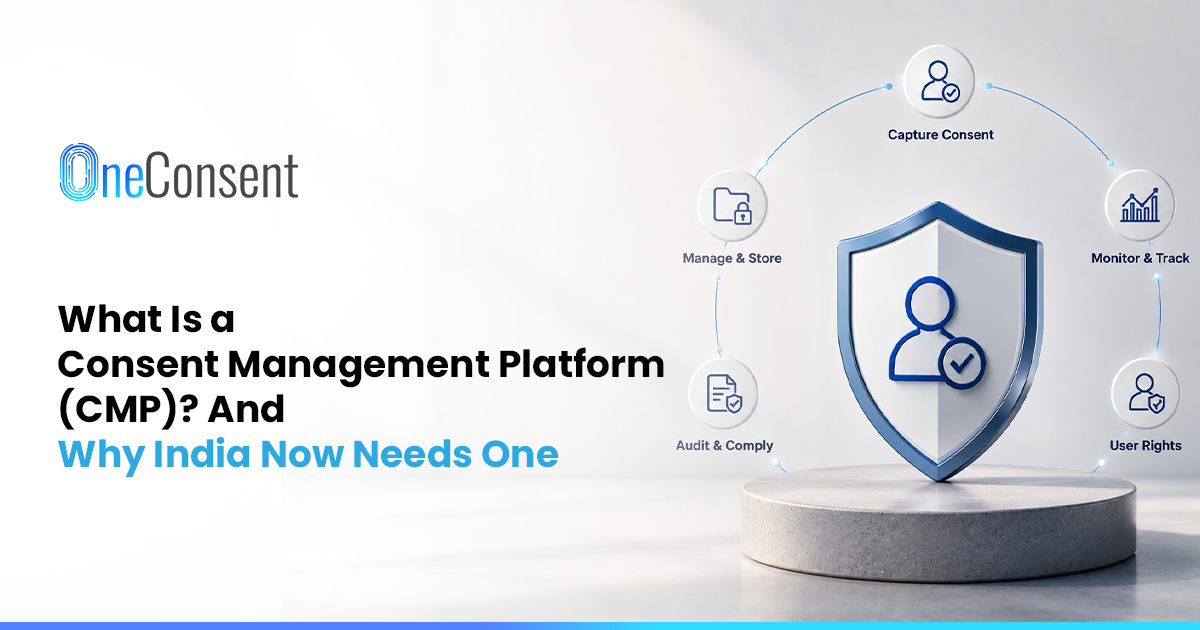
The concept of a Consent Management Platform is well established in GDPR markets. With DPDPA enforcement arriving, India's businesses now urgently need to understand what a CMP is, and why a purpose-built Indian CMP is different from a tool designed for Brussels or Berlin.
Ask a privacy team in London or Amsterdam what a CMP is and the answer comes fast, almost routine, the way someone answers a question about email servers. It has been part of the furniture there since 2018, when GDPR required every organisation collecting European data to prove, not just claim, that customers had actually agreed to it. India is only now arriving at that same point, and a surprising number of businesses still think a consent management platform is just a fancier cookie banner. It is not, and the gap between the two ideas is where a lot of DPDPA risk quietly sits.
A CMP, at its simplest, is the infrastructure that lets an organisation collect, record, enforce and audit consent for personal data processing, and it needs to do that reliably enough to hold up when a regulator, not just a customer, comes asking.
What a CMP Actually Has to Do
Start with what it actually has to do day to day. Someone signs up on a website, downloads an app, fills a form at a bank branch, or calls a support line and says yes to something over the phone. All of that has to be captured, and captured at the level of the specific purpose, not as one blanket agreement. A customer saying yes to service updates by SMS is not the same as saying yes to marketing calls, and treating them as identical is exactly the kind of shortcut that creates problems later. Once collected, that consent has to be recorded properly: a timestamp, which version of the notice the person actually read, which channel it came through, whose consent it was. And it has to sit in a log nobody can quietly edit afterward. This is where a lot of in-house builds run into trouble. A database row that can be changed is not a record, it is a suggestion.
Collecting and recording consent is only half the job, and arguably the easier half. The harder part is making sure every other system in the business actually respects what was collected. Marketing platforms, analytics tools, data warehouses, all of them need to check consent status before they touch a customer's data, not after. Otherwise a company can have a perfectly clean consent database sitting next to marketing automation that keeps emailing people who opted out three months ago. Enforcement, not collection, is usually where DPDPA gaps actually live.
Then there is withdrawal, which gets far less attention than it deserves. If someone can grant consent in one tap, they should be able to pull it back in one tap too. A revoke process buried three menus deep, or one that routes through a call centre queue, defeats the entire point of asking in the first place. And finally, someone eventually has to prove all of this happened. Audit evidence, produced on demand, not assembled the night before a hearing.
Why a CRM Field Falls Short
A lot of Indian businesses currently handle all of this through a field in their CRM labelled something like "marketing_opt_in." It feels like it solves the problem. It does not, at least not fully. That single field cannot show which notice a customer actually saw at the time, cannot separate five different purposes into five different consent records, has no live connection to the systems actually processing the data, and offers little when a customer files a data access request. And because someone with admin rights can edit it, the record's reliability is only ever as good as internal discipline. A CRM field is not a consent management platform, it is closer to a note in the margins, and the distance between the two only becomes obvious once it is tested.
Where a DPDPA CMP Differs from a GDPR One
This is also where importing a tool built for Europe runs into trouble, because DPDPA is not simply GDPR adapted for an Indian audience. It is a separate framework, shaped by different regulatory priorities and a different digital population. A consent management platform India DPDPA businesses can actually rely on needs notice support across the 22 scheduled languages, not just English and Hindi, because a notice a customer cannot read in their own language was arguably never a valid notice at all. It needs architecture built for multiple brands or client accounts under one company, a setup far more common here than it tends to be in Europe. It needs to work with Aadhaar and mobile OTP as identity checks, sit comfortably next to sector rules from RBI, SEBI and IRDAI, and support the right to nominate, letting a Data Principal designate someone to act on their behalf later, a provision that GDPR does not include. None of that can simply be layered on top of an existing GDPR-first product as a translation exercise. It has to be part of the original design, and the GDPR vs DPDPA India comparison usually shows exactly how different the two frameworks are once anyone looks closely.
The Infrastructure Most Customers Never See
Underneath all of this sits infrastructure most customers never think about: an append-only consent event store built with cryptographic integrity, a fast lookup cache so checking consent status does not slow anything down, a streaming layer that pushes changes out to every connected system the second they happen, plus a customer-facing portal for grant, revoke, DSAR and grievance requests, an admin dashboard for the compliance team, and an SDK for developers to embed consent capture wherever it is needed. Much of what gets marketed as consent management software India businesses see in demos focuses on the visible banner and toggle switches. What actually matters is the plumbing behind it, and specifically whether that audit trail is genuinely tamper-proof rather than just backed up somewhere.
The businesses still running on spreadsheets and CRM exports are not necessarily doing anything wrong today. The problem shows up the day the Data Protection Board asks for evidence, and a spreadsheet updated last Tuesday is not evidence, it is a claim. By then there is little time left to build the infrastructure that should have existed already. A proper consent platform India organisations adopt now becomes the base the rest of their compliance programme rests on, from breach notification through to regulatory reporting, and the real question worth asking is not whether this infrastructure is needed but whether the one being considered was actually designed for Indian law or adapted afterward to meet it.
OneConsent, was built around DPDPA's specific requirements from the start rather than retrofitted from a GDPR product. Organisations reviewing their consent infrastructure can see directly how it handles per-purpose consent, immutable audit logging and multilingual notices.
Backlink: OneConsent (https://oneconsent.ai)
Frequently Asked Questions
Have more questions?
Search our full DPDP knowledge base for more answers.