WhatsApp Opt-Ins vs. Marketing Consent: What DPDPA Requires
A WhatsApp opt-in and DPDPA consent answer different questions. Here is what each one proves, and how to combine them in a single consent flow.
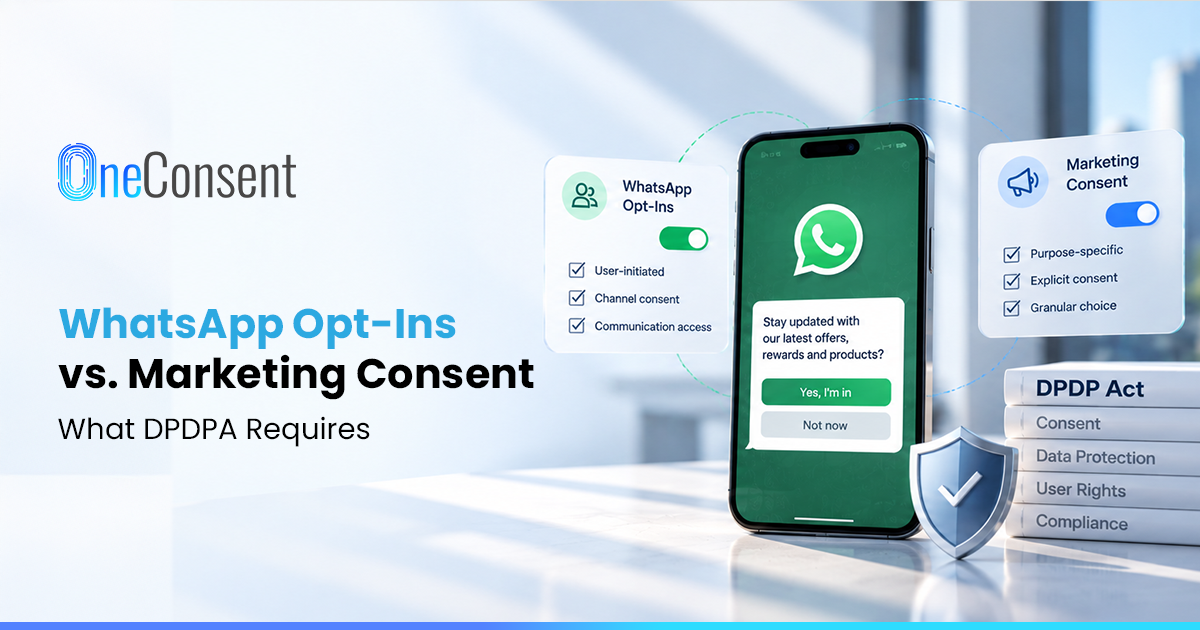
A customer taps "yes" on a WhatsApp opt-in form, and the marketing team treats the account as cleared for campaigns. Legal reviews the same account and asks a different question: what purpose did that consent cover, and can it be shown to the Data Protection Board if the customer complains? Both teams are right about what they checked. They are checking two different things.
This gap shows up often in organisations running WhatsApp campaigns at scale, because a WhatsApp opt-in and DPDPA marketing consent address different requirements. Meta owns the platform rule that protects your WhatsApp Business account from being blocked. The Digital Personal Data Protection Act, 2023, sets the legal requirements for processing a customer's personal data in India, including where that processing relies on consent for marketing. A business can satisfy one without satisfying the other. That gap turns the WhatsApp opt-in vs DPDPA marketing consent question into a genuine compliance decision for marketing and legal teams to work through together.
This article sets out what each requirement covers, where they overlap, and how to design a single consent flow that holds up under both.
What a WhatsApp Opt-In Confirms
A WhatsApp opt-in means a customer has said yes to receiving messages from a business through the WhatsApp Business Platform. This consent must follow Meta’s rules for messaging.
Before sending business-initiated messages, companies must obtain the appropriate opt-in. WhatsApp opt-in can be collected through different customer touchpoints, such as a website, app, checkout flow, or other customer interaction. The important point is that the customer has clearly agreed to receive communications from the business and that the opt-in complies with applicable WhatsApp Business messaging requirements and local law.
Good ways to get an opt-in include: checking a box when signing up or buying something, replying to a text with "yes" to confirm, filling out a form in-store, or clicking a click-to-WhatsApp ad. In this case, starting a chat is treated as permission to send messages in that conversation.
Some things don’t count as valid opt-ins. For example, if someone’s phone number was collected to process an order, using that same number later for marketing without asking again does not meet the rule. Similarly, having a phone number stored in a contact list isn’t enough.
This system helps keep the quality of messages on WhatsApp. It lets Meta know the person actually wants to hear from you. The opt-in alone does not cover everything under data protection law. It doesn’t explain why data is being used, what types of data are involved, or where someone can withdraw consent or file a complaint in India. Those details belong to policies and notices.
What DPDPA Marketing Consent Requires
DPDPA marketing consent is a legal basis for processing a customer's personal data for a specified purpose, supported by a notice, and governed by Section 6 of the Digital Personal Data Protection Act, 2023.
Under Section 4, a Data Fiduciary may process personal data based on consent, or on one of the specific legitimate uses set out separately in Section 7.
Section 7 does not provide a general legitimate-use ground for routine promotional marketing. Where personal data is processed for such marketing and no other lawful basis applies, businesses would generally need to rely on valid consent.
Section 6(1) sets the standard for that consent. It must be free, specific, informed, unconditional, and unambiguous, given through a clear affirmative action, and limited to the personal data necessary for the purpose stated. Specific means the consent is tied to a stated purpose such as promotional offers or loyalty updates, not bundled into a general "I agree to terms" checkbox that also covers unrelated processing.
Section 5, read with Rule 3 of the DPDP Rules, 2025, requires a notice before or alongside the consent request. The notice must describe the personal data being collected, the purpose of processing, and how the customer can exercise rights, including withdrawal under Section 6(4) and grievance redressal under Section 13. Section 6(4) also requires that withdrawing consent be as straightforward as giving it.
None of this requires a separate WhatsApp-specific consent screen. It requires the consent captured for marketing, on WhatsApp or any other channel, to name the purpose, be supported by an appropriate notice, and be logged in a way the organisation can produce later.
Is a WhatsApp Opt-In Enough for DPDPA Compliance?
Not necessarily. A WhatsApp opt-in can satisfy channel-level messaging requirements without automatically satisfying the DPDPA's requirements for valid consent to process personal data.
What each one confirms. A WhatsApp opt-in confirms channel-level permission to message the customer. DPDPA consent confirms a legal basis to process the customer's personal data for a named purpose.
Scope of the permission. Meta accepts a general marketing opt-in collected on any channel. DPDPA requires that permission be specific to the purpose of processing, so a general "send me offers" tick box without a stated purpose and a supporting notice sits on weaker legal ground.
What stands as evidence. Meta's platform controls focus on messaging eligibility, user feedback and quality signals, while the DPDPA places the burden on the Data Fiduciary to be able to prove valid consent where consent is relied upon.
Withdrawal. A customer opt-out should be reflected in subsequent WhatsApp marketing communications in accordance with applicable WhatsApp Business messaging requirements. The DPDPA requires the withdrawal mechanism to be as easy to use as the original consent action, and expects that withdrawal to be honoured across every system processing that data, including systems beyond the messaging channel where it was raised.
A customer who opts in through a click-to-WhatsApp advertisement, for instance, satisfies Meta's implicit-consent rule for that specific conversation. That same interaction is unlikely to carry the notice and purpose specificity that Section 6 expects for ongoing promotional messaging, since no notice was presented and no purpose was named before the conversation began.
Why the Distinction Matters for a Marketing Team
Treating a WhatsApp opt-in as the full compliance answer creates a gap that only becomes visible when a customer raises a grievance, or the Data Protection Board asks for evidence of consent.
A useful way to frame this is as a design opportunity for the consent capture flow itself. A consent flow built to capture purpose-specific, notice-backed consent at the same moment a WhatsApp opt-in is collected gives the marketing team one clean interaction that satisfies Meta's platform policy and helps address DPDPA consent requirements, instead of two separate processes maintained on different systems with different logs.
This also matters operationally. Marketing teams running WhatsApp, SMS, and email from connected but separately governed systems often find that a withdrawal registered on one channel takes time to reach the others, and during that window a message can go out to a customer who has already withdrawn consent. Building consent and channel preferences around a connected consent record can reduce that gap and make withdrawals easier to enforce consistently across systems.
Designing a Consent Flow That Satisfies Both Requirements
A consent flow that holds up under both frameworks generally follows this sequence.
State the purpose before the opt-in. Name what the customer is agreeing to, such as promotional offers or loyalty updates, instead of presenting one general marketing checkbox.
Present the notice at the same step. In line with Section 5 and Rule 3, show the personal data being collected and the purpose behind it, along with the withdrawal option and the route for raising a grievance, before or alongside the consent action.
Capture an unambiguous affirmative action. Use an unchecked checkbox, an explicit SMS reply, or an equivalent active step. Pre-ticked boxes and inferred consent from an unrelated action do not meet the Section 6 standard.
Log the consent with its context. Record the purpose and the notice version shown, along with the timestamp and the channel. Maintaining this context can help the organisation demonstrate how consent was obtained if it is later questioned.
Sync withdrawal across every connected channel. When a customer withdraws consent on WhatsApp, the same withdrawal should reflect on the CRM, SMS, and email systems without a manual step in between.
Review the flow against DPDP Rules milestones. Rule 4 provisions for Consent Managers take effect from 13 November 2026, and the most substantive consent and Data Fiduciary obligations under the Act become effective from 13 May 2027. Reviewing consent workflows against this timeline helps a compliance team plan implementation ahead of each milestone.
For a deeper look at how to design the notice and opt-in screens themselves, read our guide on building a DPDPA-compliant consent notice.
A Quick Self-Check for WhatsApp Marketing Consent
Before your next WhatsApp campaign goes live, it is worth reviewing your consent flow against these questions:
Does your WhatsApp opt-in name a specific purpose, or does it read as a general marketing agreement?
Is a notice shown to the customer before or alongside the consent request, covering what data is collected and why?
Can your team produce, for any individual customer, the purpose, notice version, and timestamp attached to their consent?
If a customer withdraws consent on WhatsApp, does that withdrawal reach your CRM, SMS, and email systems without manual intervention?
Is your grievance and withdrawal process as easy for the customer to use as the original opt-in was?
Where OneConsent Fits
OneConsent captures purpose-based consent at the point of interaction and applies it consistently across WhatsApp, SMS, email, app, and point-of-sale channels, so the purpose named at consent capture stays attached to the customer record wherever that data is used.
The platform's consent sync hub carries withdrawal and preference changes across connected systems, so a customer who withdraws consent on one channel does not continue to receive messages from another. Consent evidence and audit trail capabilities log the purpose, notice version, and timestamp behind every consent action, giving compliance teams a clear record when a grievance or a Data Protection Board query asks how a specific consent was obtained.
A Practical Next Step
If your marketing team is currently relying on WhatsApp opt-in status as a stand-in for DPDPA consent, a useful starting point is mapping your existing WhatsApp, SMS, and email opt-in flows against the purpose-specificity and notice requirements set out above. The OneConsent team can walk through this mapping against your current MarTech stack and consent workflows.
Book a demo to review how a purpose-based consent flow would work across your marketing channels, or visit OneConsent to explore the platform in more detail.
Frequently Asked Questions
Have more questions?
Search our full DPDP knowledge base for more answers.