Consent Management Software for CRM, Loyalty and Marketing
A single phone number shared at a billing counter can end up in six different systems within a day. Under the DPDP Act, each of those systems needs to respect what the customer actually agreed to.
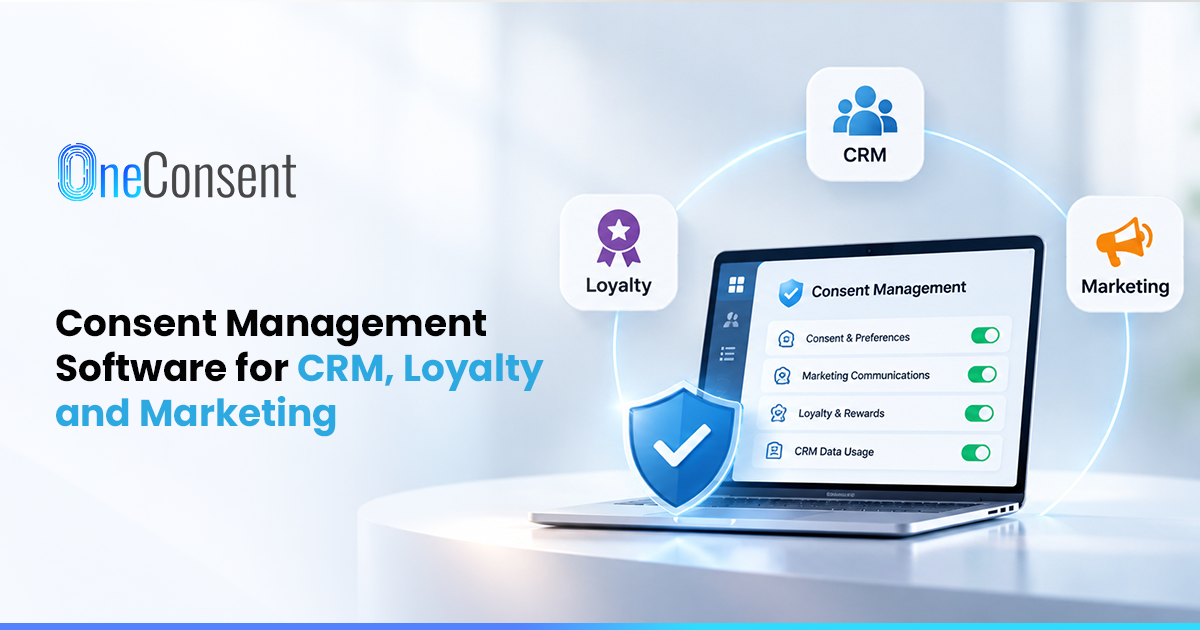
A customer shares a mobile number at the billing counter to join a loyalty programme. Within a day, that number is stored in the POS system, the loyalty engine, the CRM, an SMS vendor’s platform, a WhatsApp business account and perhaps a custom audience for digital ads. Each system can use the number, and few of them record what the customer agreed to.
Under the Digital Personal Data Protection Act, 2023, that gap matters. CRM, loyalty and marketing teams work with customer data every day, so consent problems can show up in their systems first.
Where Consent Breaks Down in Customer Systems
Most issues are not dramatic. They come from everyday practices that were common before the Act.
A sign-up form with one checkbox covering points, offers and “partner communications” is a common example. So is a customer who unsubscribes in the app but keeps getting SMS offers because the SMS vendor’s list was never updated. Another is loyalty purchase history being reused for ad targeting when the customer only agreed to earn and redeem points.
None of these needs bad intent. They happen because consent is captured in one place and used in many others.
What the DPDP Act Expects
The Act does not mention CRM or loyalty programmes by name. Several provisions apply directly to how these systems work. The provisions on notice, consent, children’s data and erasure apply from 13 May 2027.
Valid consent. Under Section 6(1), consent must be free, specific, informed, unconditional and unambiguous, given through a clear affirmative action, and limited to the specified purpose. A pre-ticked box or a single checkbox for unrelated purposes is hard to defend against that standard.
A clear notice. Rule 3 of the DPDP Rules 2025 requires a notice that can be understood on its own, with an itemised description of the personal data and the specific purpose. It must also explain how to withdraw consent, exercise rights and complain to the Data Protection Board.
Easy withdrawal. The ease of withdrawing consent must be comparable to the ease of giving it. Once a customer withdraws, the business must stop processing within a reasonable time and make sure its processors, such as SMS or email vendors, stop too.
Proof. If there is a dispute, Section 6(10) places the burden of proving that a notice was given and consent obtained on the Data Fiduciary.
Erasure. Personal data must be erased when consent is withdrawn or the purpose is no longer served, unless another law requires it to be kept. For e-commerce entities and social media intermediaries with at least two crore registered users in India, and online gaming intermediaries with at least fifty lakh, the Rules set a three-year period from the user’s last contact for specified purposes, with notice to the user at least 48 hours before erasure.
Children. Section 9 requires verifiable consent from a parent or lawful guardian before processing the data of a child or of a person with a disability who has a lawful guardian. It also prohibits tracking, behavioural monitoring and targeted advertising directed at children, subject to exemptions in the Rules.
Not every use of customer data needs consent. Section 7(a) covers data a person voluntarily provides for a specific purpose, such as a phone number shared to receive a purchase receipt by SMS. That ground covers the receipt and does not automatically extend to promotional messages. Transactional use and marketing use need to be kept apart.
Related Reads: DPDPA for Retail & Loyalty Programmes: CRM Data and Consent | OneConsent A closer look at how retail brands can structure loyalty sign-ups and customer profiles around purpose-specific consent.
Why a CRM Alone Is Not Sufficient
Many CRMs store a simple opt-in field: yes or no. That field may not capture which notice the customer saw, which purpose they agreed to, through which channel, or when they changed their mind. Marketing tools add their own suppression lists, and loyalty platforms keep their own member preferences. Over time, the same customer can have three different consent states in three systems.
A CRM is built to manage relationships, and the record of consent across every system that touches customer data needs a dedicated layer.
What Consent Management Software Adds
Consent management software operates between the points where consent is collected and the systems that use the data. The platform enables organisations to:
Capture consent purpose by purpose at every touchpoint, including stores, apps, websites, call centres and WhatsApp
Link each consent to the notice version, timestamp and channel
Give customers a preference centre where they can change choices without contacting support
Push withdrawals to the CRM, loyalty engine and marketing vendors through APIs, so all systems reflect the same choice
Flag data that has reached the end of its retention period
Produce consent records the organisation can rely on if the Board seeks information
The law does not require any particular DPDP compliance software. For brands with large customer bases and many channels, a dedicated DPDP compliance platform can make these obligations easier to meet consistently and easier to prove.
A Note on Consent Managers
The Act also creates Consent Managers, entities registered with the Data Protection Board that act as a single point of contact for individuals to give, manage, review and withdraw consent through an accessible, transparent and interoperable platform. Registration requires, among other conditions, a company incorporated in India with a net worth of at least ₹2 crore, and the registration provisions apply from 13 November 2026.
A business does not need to become a registered Consent Manager to manage consent on its own systems. A consent management platform in India used by a brand for its own customers is a separate thing, and the two should not be confused when evaluating vendors.
Choosing the Right Partner
A search for DPDP compliance companies in India returns law firms, advisory practices and software vendors. A brand can start with a DPDP compliance consultation to interpret obligations and set governance, then use DPDP compliance software to run the processes day to day. Useful points to confirm with a software vendor include:
Capture of consent at offline touchpoints such as POS terminals
Integration with the CRM, loyalty and messaging tools already in use
Automatic delivery of a withdrawal to third-party vendors
Notices available in English and the Eighth Schedule languages
Export of consent records for an audit or a Board inquiry
Start With a Map of Customer Data
Before configuring any tool, a brand needs to know which customers it holds data on, for what purposes, through which touchpoints and in which systems. This exercise can surface old lists and integrations that teams had lost track of.
OneConsent supports this through a structured discovery flow that maps industries, data principals, purposes, touchpoints, data fields, business applications and storage. For each purpose, it records default consent, retention period and consent validity. The output is a consent matrix along with a system and storage inventory, which marketing, CRM, legal and IT teams can use as a shared starting point. To see how the OneConsent consent management platform supports CRM, loyalty and marketing teams under the DPDPA, book a product demo.
Meenali Chourasia is a Product Manager with 10+ years of experience leading product strategy, roadmaps and growth across mobile apps, websites and SaaS platforms. She has built and scaled consumer and enterprise products at MTAP Technologies, Hungama Digital Media and Justdial, where she drove measurable impact on user engagement, retention and revenue through data-led decision making. Her expertise spans strategic roadmaps, product design, requirements gathering and KPI tracking using tools like Amplitude and Firebase. Meenali holds a PGDM in Marketing and International Business from New Delhi Institute of Management. At Easyrewardz, she focuses on shaping consent-first product experiences that help Indian enterprises navigate the DPDP era with confidence.
See all articles by meenaliFrequently Asked Questions
Have more questions?
Search our full DPDP knowledge base for more answers.