DPDPA's Consent Monopoly Problem: Why Platform Lock-In Is a Compliance Risk
There is a structural tension within DPDPA's consent model that regulators and businesses need to address: what happens when dominant digital platforms control the consent infrastructure?
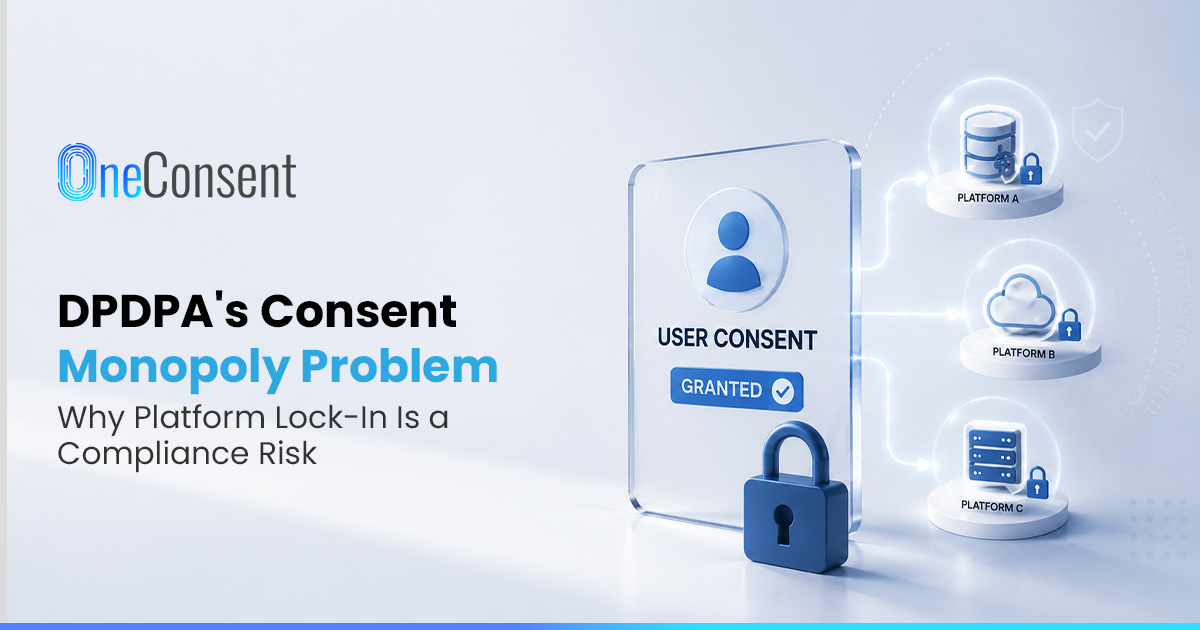
The DPDP framework is creating a new layer of infrastructure around consent. For enterprises, the question is no longer only whether consent is collected correctly. It is also where the consent record sits, who can access it, how it connects with enterprise systems, and what happens if the underlying technology provider changes its terms.
As enterprises increasingly rely on third-party consent infrastructure and Consent Managers, these technology providers can become an important part of the compliance architecture rather than simply another channel through which consent is collected. This is a structural pattern worth understanding early, so businesses can plan for it as part of ordinary vendor and technology decisions.
Where Does Your Consent Infrastructure Sit?
Enterprise consent is rarely collected through a single system. A customer may interact with a brand through its website, mobile app, loyalty programme, POS, CRM, CDP, marketing platform or third-party service. Each interaction can create or update a consent or preference signal that needs to remain consistent across the customer journey.
Consent is increasingly becoming an infrastructure layer rather than a simple interaction at the point of data collection. The DPDP framework provides for Consent Managers, and the DPDP Rules, 2025 specify requirements around their registration, interoperability and consent records. Enterprises therefore need to think about where consent is managed and how that information moves across their technology ecosystem.
The enterprise concern is different from market dominance itself: dependency. When a third-party platform becomes deeply embedded in how consent is collected, stored, updated and shared across multiple systems, it can create vendor lock-in, limited interoperability and operational dependency on that provider's APIs, data formats and access policies.
Where Consent Technology Can Create Vendor Dependency
Consider an enterprise that manages consent across its website, mobile app, loyalty programme, POS systems, CRM, CDP and marketing platforms through multiple integrations. Over time, one external consent platform can become a critical dependency for a significant part of that consent infrastructure.
The technology may work effectively, but a dependency emerges if the organisation cannot easily export historical records, migrate workflows, connect to another platform or continue accessing consent evidence independently.
The more important enterprise question is control. Who can access the consent record? Can the organisation retrieve its historical records? Can those records be migrated? And can the latest consent and preference signals continue flowing to every system that relies on them?
Why This Should Matter to DPDPA-Regulated Businesses
The DPDPA places responsibility on the Data Fiduciary for complying with the Act, even when technology or third parties are involved in processing personal data. Where consent is the basis for processing and its validity is questioned in a proceeding, the Data Fiduciary must be able to demonstrate that the required notice was provided and that consent was obtained in accordance with the Act and Rules.
This makes access to reliable consent evidence an important consideration when selecting and governing third-party consent infrastructure.
Consent-record portability is therefore an important technology and vendor-governance consideration for Data Fiduciaries, particularly where a third-party platform becomes a critical part of the compliance architecture. The goal is to ensure that dependence on an external provider does not prevent an organisation from accessing the consent evidence it needs for its own compliance processes.
What Happens When the Vendor Changes?
Consider a company whose consent workflows depend heavily on a third-party consent platform or external integration layer. If that provider changes its pricing, is acquired, changes its API policies or restricts access to historical consent records, the Data Fiduciary could face an operational challenge in retrieving evidence needed for its own compliance processes.
This is why vendor continuity, data export and transition planning should form part of consent management procurement and governance.
Consent Records Function as Legal Evidence
Consent records serve a purpose beyond internal tracking or marketing segmentation: they provide evidence of how consent was obtained and managed.
Where consent is the basis for processing and its validity is questioned in a proceeding, the Data Fiduciary must be able to demonstrate that the required notice was provided and consent was obtained in accordance with the Act and Rules.
That makes an important vendor-governance question worth asking: what happens if that evidence sits inside a platform the business does not directly control?
If access to historical records depends on a third party's systems, APIs or contractual terms, the organisation's ability to retrieve and use that evidence can become an operational dependency.
Why Interoperability Matters
Other regulated sectors offer useful examples of why interoperability matters. Banking has established frameworks for moving financial relationships and services between institutions, while mobile number portability allows consumers to switch telecom operators without losing their number. The broader lesson is simple: when switching infrastructure is easier, dependency on an individual provider is reduced.
Applying the Same Logic to Consent
The same principle can inform consent architecture. Data Fiduciaries should ideally be able to export, migrate and connect consent records across their technology ecosystem, regardless of where that consent was originally captured.
This is particularly relevant as the Consent Manager framework develops. The DPDP Rules, 2025 require registered Consent Managers to operate interoperable platforms through which Data Principals can give, manage, review and withdraw consent. The Rules also require Consent Managers to maintain records of consents given, denied or withdrawn, related notices and certain data-sharing activity. Those records must be accessible to the Data Principal and capable of being provided in machine-readable form on request.
For organisations managing consent across multiple brands or business units, multi-tenant consent management can help maintain separate consent records and workflows while preserving central control.
Without adequate portability and interoperability, enterprises can become increasingly dependent on the technology provider through which their consent records and workflows are managed.
What Businesses Can Do Now
Enterprises do not need to wait for further regulatory guidance to address these technology risks. Consent infrastructure can be evaluated today as part of privacy, security, architecture and vendor-governance decisions.
These considerations are particularly relevant for enterprises evaluating consent management platforms in India, where technology choices made today can influence long-term compliance operations.
Choose Open, Portable Infrastructure
Enterprises should assess whether a consent management platform supports portable, machine-readable records and practical export capabilities. Proprietary formats that make migration difficult can increase long-term vendor dependency.
When evaluating DPDPA compliance software, portability and export capability should sit alongside security and integration on the vendor checklist.
Read more about evaluating consent management vendors.
Make Portability a Contract Requirement
Data export, retention and transition clauses should be considered as part of consent-platform vendor contracts rather than treated as an afterthought. These requirements are worth raising during procurement, before a contract is signed.
The contract should also address what happens to consent records and related evidence if the relationship ends, the provider is acquired or the technology platform changes.
Keep an Independent Copy of Consent Records
Where appropriate, maintaining an independently accessible copy or export of critical consent evidence can reduce dependence on a third-party platform as the sole point of access.
The objective is not necessarily to duplicate every record across systems. It is to ensure that the organisation can access the information it needs to manage consent and demonstrate compliance.
Engage With the Interoperability Conversation
Enterprises can contribute to the evolving interoperability conversation by engaging with industry bodies, technology providers and policy stakeholders as the DPDP ecosystem develops.
These measures can be incorporated into existing privacy, procurement, security and enterprise-architecture processes without waiting for additional regulatory action.
Questions to Ask a Consent Management Vendor
Before selecting a consent management platform, enterprises should ask:
Can we export our complete consent history?
Is the exported data machine-readable?
Can consent records be migrated to another platform?
Are APIs documented and accessible?
Can historical consent evidence be retrieved independently?
What happens to our records if the contract ends?
Can consent and preference signals be synchronised across CRM, CDP and marketing systems?
Are consent notices, purposes, versions and withdrawal events preserved?
How are consent records protected and retained?
What happens to the records if the vendor is acquired or its platform architecture changes?
These questions help move consent management from a point-in-time implementation decision to a longer-term enterprise architecture consideration.
Where This Leaves the Ecosystem
Consent infrastructure is becoming an important part of enterprise privacy architecture under the DPDP framework. As organisations adopt Consent Managers and third-party consent technologies, the question is not simply whether consent can be collected. It is whether consent records remain accessible, auditable, interoperable and usable across the systems that depend on them.
For Data Fiduciaries, portability and vendor independence should therefore be considered alongside security, integration and compliance when evaluating consent infrastructure.
The objective is not to avoid third-party technology. It is to ensure that the technology strengthens compliance without creating unnecessary operational dependency.
How OneConsent Supports Portable, Auditable Consent Records
OneConsent is designed to give Data Fiduciaries an accessible, time-stamped record of consent and related audit evidence. Its API-based integrations connect consent workflows with an organisation's existing enterprise systems, while Consent Sync Hub helps keep consent and preference signals aligned across connected applications.
The objective is to make consent evidence accessible and usable across the enterprise rather than dependent on a single closed application or workflow.
For enterprises evaluating consent management platforms, portability, interoperability and auditability should be treated as important architecture requirements alongside security and integration.
Explore OneConsent to see how portable, auditable consent records can fit into an enterprise DPDP compliance architecture.
Book a demo to see how OneConsent connects consent management with existing enterprise systems.
Frequently Asked Questions
Have more questions?
Search our full DPDP knowledge base for more answers.