Consent Management vs Preference Management: Do You Need Both?
A customer who turns off WhatsApp offers might be changing a preference, or might be withdrawing consent. Under the DPDP Act, the difference decides whether processing can continue.
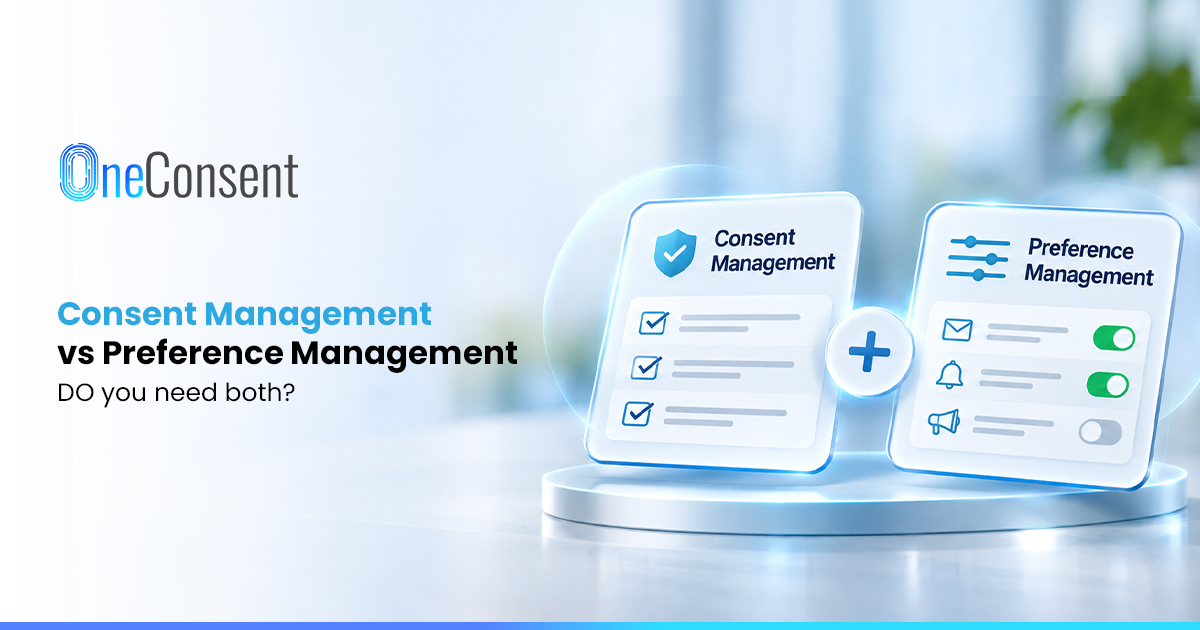
Consent management and preference management are often treated as one capability. Vendors sell the two as a single product and teams use the words interchangeably in meetings. In many businesses, a “preference centre” ends up doing the work of a consent tool.
The comparison of consent management vs preference management comes down to two different questions. Consent management records the permission a person has given your business to use personal data for a stated purpose. Preference management records how that person would like to hear from you once the permission exists. Under the Digital Personal Data Protection Act, 2023 (DPDP Act), the first carries legal duties wherever consent is the ground for processing. The second serves the customer relationship. Several everyday marketing choices belong to both categories, and those are the ones your teams need to classify with care.
The consent provisions of the Act and the notice requirements in the DPDP Rules, 2025 apply from 13 May 2027. Until then, your marketing, privacy and IT teams can agree which customer choices are consent decisions and which are preferences.
What Consent Management Covers
Consent management is the process of collecting and recording consent for each purpose, then updating and honouring it as the customer’s choices change. From 13 May 2027, the DPDP Act and the Rules give the process a defined legal shape:
Valid consent. Consent has to be free, specific, informed, unconditional and unambiguous. A clear affirmative action from the customer signals it. Consent covers only the personal data needed for the specified purpose (Section 6(1)).
A standalone notice. A customer should be able to understand the notice on its own, in clear and plain language. The notice itemises the personal data and the purpose. A link in the notice lets the customer withdraw consent (Rule 3).
Easy withdrawal. A customer can withdraw at any time, with ease comparable to giving consent (Section 6(4)). Processing completed before the withdrawal remains lawful (Section 6(5)).
Stopping the processing. After a withdrawal, the business and its Data Processors stop processing within a reasonable time. Processing that the Act or another law requires or authorises without consent can continue (Section 6(6)).
Proof. If a question arises in a proceeding, it falls on the Data Fiduciary to show that notice was given and consent was obtained (Section 6(10)). The Data Fiduciary is the business that decides why and how the personal data is processed.
The output of consent management is a record showing who agreed to what and when, along with the notice version and the channel through which the customer agreed.
Consent is one of two grounds for processing under the Act. Section 7 lists certain legitimate uses, such as a customer who voluntarily shares a phone number at a pharmacy counter to receive a payment receipt by SMS. A good consent setup records the ground that applies to each purpose. Teams can then tell which processing a withdrawal affects.
A Consent Manager under the Act is an entity registered with the Data Protection Board, through which a person can give, manage, review or withdraw consent; the registration framework in Rule 4 took effect on 13 November 2026. A consent management platform is software that your business runs to maintain its own consent records.
Related Reads: What Is a Consent Management Platform (CMP)? And Why India Now Needs One
What Preference Management Covers
The term “preference management” does not appear in the DPDP Act. It describes the choices a customer makes about the experience of hearing from you: preferred channels and message frequency, along with topics of interest and language.
For example, a customer of an appliance retailer may welcome offers on home appliances, provided they arrive by email once a week and are written in Hindi. None of those choices is a legal permission on its own. Each one helps the marketing team send fewer and more relevant messages. Customers who receive relevant messages have a reason to stay subscribed.
Preference data is still personal data, so the same care applies to how the business stores and shares it.
Preferences do carry regulatory weight on telecom channels. Under TRAI’s Telecom Commercial Communications Customer Preference Regulations, 2018, a mobile subscriber can register preferences by category and mode of commercial communication, as well as by time band and day of the week. Senders of promotional SMS and voice campaigns are expected to respect those registered choices. Telecom preference handling continues alongside consent under the DPDP Act.
Where Consent and Preferences Overlap
Some choices presented as preferences are consent decisions in practice.
Take a customer who turns off “offers on WhatsApp”. Depending on how the business first collected consent, the action may be a withdrawal of consent for marketing on that channel. A customer who switches off “personalised recommendations” may be ending consent for profiling. If only a marketing tool stores such choices, processing can continue after the ground for it has ended.
Other preferences operate inside a consent that already exists. A change from daily to weekly messages leaves the permission untouched, as does a choice of topics within a marketing purpose the customer has agreed to. Such changes alter how the marketing team carries out the processing.
Consent Management vs Preference Management at a Glance
Consent management | Preference management | |
|---|---|---|
Core question | Whether the business is allowed to process this data for this purpose | How the customer wants to be contacted within that permission |
Legal status under the DPDP Act | Required where consent is the ground for processing | No defined term in the Act; good practice, with separate TRAI rules for SMS and voice |
Typical choices | Marketing, profiling, data sharing, analytics | Channel, frequency, topics, language |
Main owner | Legal, privacy, compliance | Marketing, CRM, customer experience |
What it must produce | Provable records, timely withdrawal, erasure unless another law requires retention | Relevant communication, fewer full opt-outs |
A practical test helps your team classify each toggle. If switching a choice off means a type of processing should stop, treat it as consent. If the change affects only the format or timing of something already agreed, treat it as a preference.
Applied to the choices commonly found in a preference centre, the test gives a starting classification that your privacy team should confirm against the wording of your notices:
Treat as consent: promotional messages on a channel where consent was captured channel by channel; personalised recommendations and profiling; sharing data with partner brands.
Treat as preference: message frequency; topics within an agreed marketing purpose; language; preferred time of day.
Check the original consent: a single channel switched off when the original consent covered marketing across all channels.
The Risk of Running Them Separately
In many businesses, the legal or privacy team owns consent while the marketing stack stores preferences. Problems appear when the two records disagree.
Consider a customer who withdraws marketing consent through a privacy portal. The email platform reads from its own preference table, where “weekly digest: on” is still set. The next digest goes out. The reverse can also happen. A customer turns off WhatsApp in the preference centre while the consent record continues to show marketing consent as active across channels. The next campaign tool then picks the customer up.
Both situations produce unwanted messages. Once the consent provisions apply, they may also mean processing without a valid ground. The same gap can extend to Data Processors such as an SMS gateway or a WhatsApp service provider. A withdrawal has to reach each party that processes the data on your behalf.
Related Reads: DPDPA Consent Withdrawal Guide
Do You Need Both?
Most consumer-facing businesses need both. Consent management meets the legal requirement, and preference management keeps customers engaged after they have said yes.
Two principles help you connect the two disciplines:
One record of truth. Hold consent and preferences on the same customer record. A change made in one place is then visible to each system that sends messages.
Preferences depend on consent. A preference should never permit something that consent does not cover. When a customer withdraws consent, the related preferences should switch off automatically.
A clear order of decisions makes both principles easier to apply. Decide the purpose first and the channel second, with frequency or topic settled last. Ownership can follow a similar split. The privacy team classifies each choice and marketing configures the preference centre, while IT carries changes through to connected tools and processors.
Because the Act expects withdrawal to be as easy as giving consent, a customer who opted in with one tap should be able to opt out from the preference centre with similar effort.
A B2B business with a small contact list and only service communications may need only basic consent records, whereas a retailer or bank with millions of customers across several channels will generally need both, connected to each other.
Related Reads: Building a DPDPA-Compliant Customer Portal.
How a Consent Management Platform Brings Them Together
A consent management platform in India should let your teams manage consent and preferences from one place. A well-designed platform can also flag when a preference change is a consent withdrawal and keep records that can support the proof expected under Section 6(10). The Act does not prescribe any particular DPDP compliance software.
Many organisations begin with a DPDP compliance consultation to decide which purposes need consent and which rely on another ground. Enterprises comparing DPDP compliance companies in India will find both advisors and software providers, and many use the two together: legal guidance to set the rules and software to run them day to day.
How OneConsent Helps You Manage Consent and Preferences Together
OneConsent brings consent management and preference management onto one platform, so the permission a customer gives and the way that customer wants to be contacted are held on the same record. The consent and preference management platform is designed for the DPDP Act and for Indian customer journeys.
Key features
Purpose-based consent capture: collect consent for each purpose across web and app touchpoints through the Web SDK, Mobile SDK and APIs.
Preference centre: give customers one place to review consent, change channel, frequency and topic choices, and withdraw consent.
Purpose and data field mapping: link each purpose and sub-purpose to the personal data fields it uses.
Notice management: create and version privacy notices, with each consent record linked to the notice version the customer saw.
Consent Sync Hub: synchronise consent and preference signals to connected CRM, marketing and messaging applications.
Consent evidence and audit trails: maintain time-stamped records of consent, preference changes and withdrawals.
Consent analytics: track consent trends, preference choices and withdrawals across touchpoints.
What sets OneConsent apart
One record for consent and preferences: a withdrawal can switch off the related preferences, and a preference never extends past the consent it depends on.
Built for the DPDP Act: purposes, notices, withdrawal and proof of consent follow the structure of the Act and the DPDP Rules, 2025.
Consent checks across channels: consent status can be checked across web, apps, POS and campaigns before data is used.
Opt-down controls: flexible preferences let a customer reduce frequency or change channel, which can lower full opt-outs.
A good starting point is a map of purposes. OneConsent builds this map through a structured discovery flow covering data principals, purposes and touchpoints, along with data fields, business applications and storage. For each purpose, the flow records default consent, retention period and consent validity. The resulting consent matrix gives teams a clear list of purposes, showing which choices need consent and which are preferences. The consent management vs preference management decision then becomes a classification exercise for each customer choice. To see how the consent management platform supports both under the DPDPA, visit the OneConsent platform. Your team can book a OneConsent demo to review how the consent matrix would apply to your own purposes and channels.

Meenali Chourasia is a Product Manager with 10+ years of experience leading product strategy, roadmaps and growth across mobile apps, websites and SaaS platforms. She has built and scaled consumer and enterprise products at MTAP Technologies, Hungama Digital Media and Justdial, where she drove measurable impact on user engagement, retention and revenue through data-led decision making. Her expertise spans strategic roadmaps, product design, requirements gathering and KPI tracking using tools like Amplitude and Firebase. Meenali holds a PGDM in Marketing and International Business from New Delhi Institute of Management. At Easyrewardz, she focuses on shaping consent-first product experiences that help Indian enterprises navigate the DPDP era with confidence.
See all articles by meenaliFrequently Asked Questions
Have more questions?
Search our full DPDP knowledge base for more answers.